In Simple Words
If a stranger calls asking whether you earned money under the table this week, you will likely say no out of fear. But if the social worker who helped register you for assistance calls back, you are much more likely to report your true informal work. As a result, surveys by strangers miss informal jobs, whereas follow-ups by trusted staff capture them accurately.
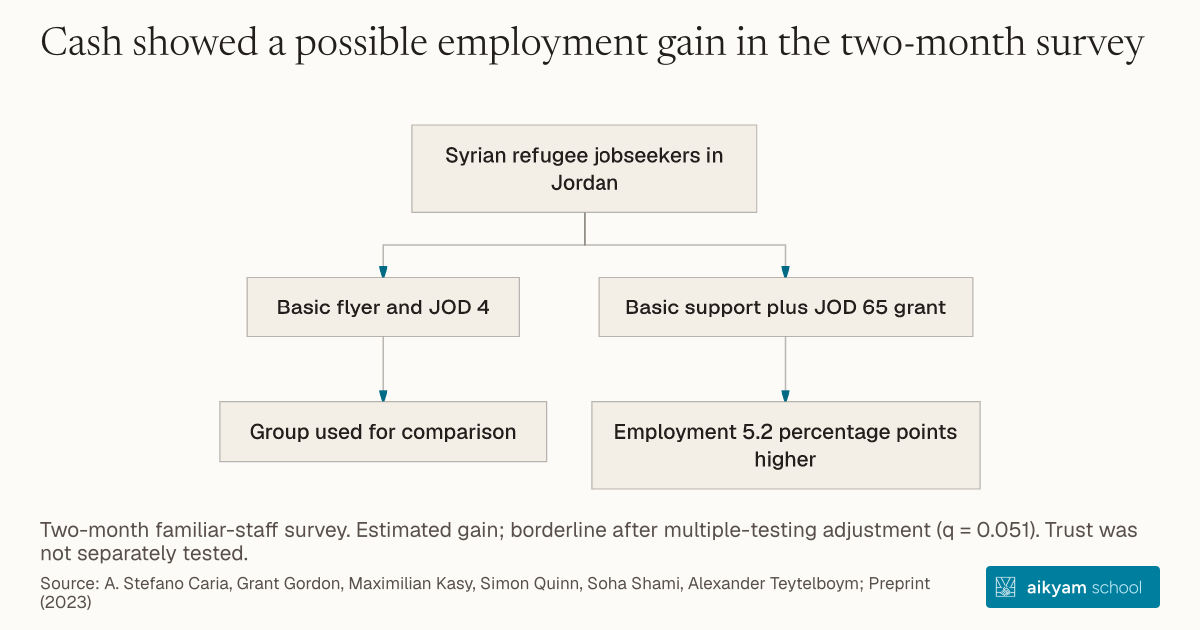
Syrian refugee jobseekers in Jordan
- Basic flyer and JOD 4
- Group used for comparison
- Basic support plus JOD 65 grant
- Employment 5.2 percentage points higher
Two-month familiar-staff survey. Estimated gain; borderline after multiple-testing adjustment (q = 0.051). Trust was not separately tested.
See source →Research question
Short-term survey data collected by unfamiliar enumerators often underreports informal employment among refugee populations due to mistrust and legal concerns, creating false-negative treatment signals in field evaluations.
Participants
N = 3,668 jobseekers surveyed in rapid follow-up vs N = 3,593 surveyed in 2-month follow-up (Syrian refugees and Jordanians).
Study Design
Comparative empirical analysis of 6-week rapid phone surveys conducted by an unfamiliar enumerator versus 2-month/4-month surveys conducted by familiar Employment Service Officers (ESOs) who completed intake interviews.
Results
6-week rapid surveys by unfamiliar enumerators showed near-zero employment impacts (0.6 percentage points for cash, p = 0.296; control mean 4.9%), whereas 2-month ESO surveys revealed 5.2 percentage point employment gains for Syrian refugees (p = 0.017; control mean 9.1%), with significant job increases occurring just below the formal minimum wage.
Takeaway
Employ familiar, trusted field staff rather than anonymous survey agents to administer follow-up evaluations when measuring informal labor market outcomes among vulnerable populations.
Source and citation
See source →Read alongside the research
Plain-English glossary
Original explanations, informed by the references below. Examples are illustrations, not data from the studies above. The research text stays unchanged.
- Follow-up
Collecting more information about participants later in a study to see what has happened to them. The term can also mean the length of time researchers keep track of them.
ExampleResearchers interview the same workers three months after a programme ends. That later interview is a follow-up.
GET-IT glossary · Follow-up ↗Read more about follow-up →- Percentage points
The difference between two percentages.
ExampleA rise from 40% to 50% is 10 percentage points. Relative to the starting value, that is a 25% increase.
Office for National Statistics · Percentages ↗Read more about percentage points →