In Simple Words
Imagine organizing a crowded speed-dating event where participants cannot speak or share profile details—simply placing people in the same room does not help anyone find a compatible long-term partner if nobody can evaluate each other's true traits.
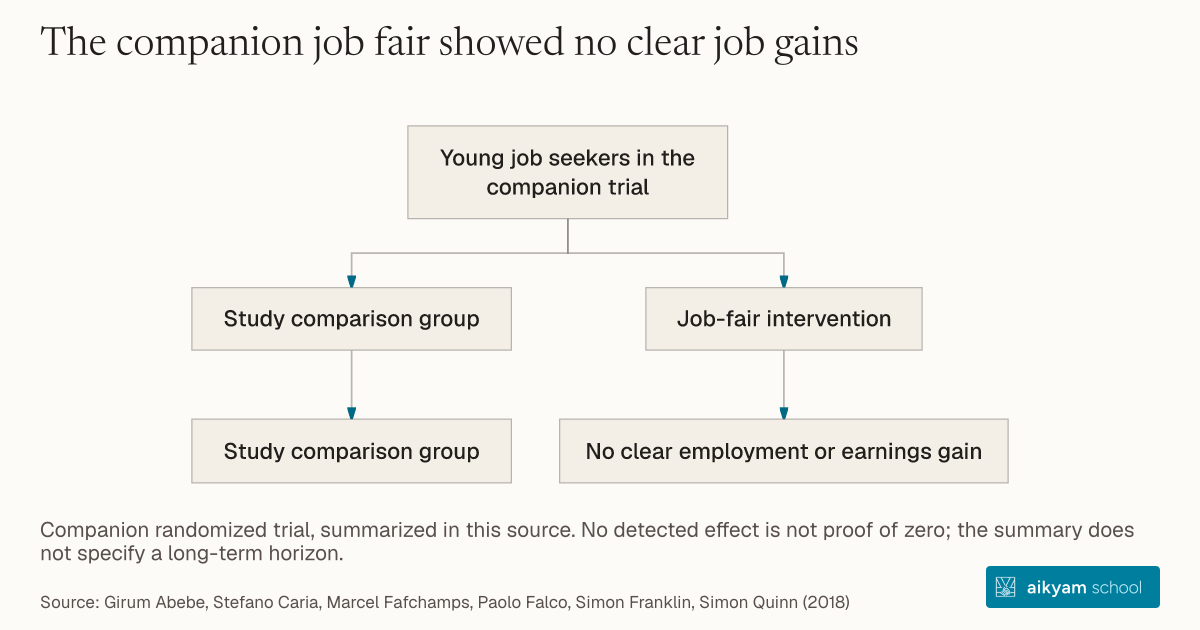
Young job seekers in the companion trial
- Study comparison group
- Study comparison group
- Job-fair intervention
- No clear employment or earnings gain
Companion randomized trial, summarized in this source. No detected effect is not proof of zero; the summary does not specify a long-term horizon.
See source →Research question
Policy interventions that simply convene job-seekers and employers in physical space without providing verified skill information fail to resolve core labor market exclusion or increase employment rates.
Participants
N = 1,007 youth job-seekers and a random sample of participating employers in Addis Ababa, Ethiopia.
Study Design
Parallel two-sided field experiment (Abebe et al., 2017 companion study) randomizing attendance at job fairs at both firm and worker levels.
Results
Uncredentialed job fairs produced zero statistically significant long-term impacts on youth employment or earnings, functioning only to realign biased subjective beliefs regarding workforce market availability.
Takeaway
Avoid funding passive job fairs or physical matching events unless they incorporate standardized candidate skill assessment and certification mechanisms.
Source and citation
See source →Read alongside the research
Plain-English glossary
Original explanations, informed by the references below. Examples are illustrations, not data from the studies above. The research text stays unchanged.
- Statistically significant
A label used when a result passes a chosen statistical threshold, often p < 0.05. It does not show how large or useful an effect is. A result that is not statistically significant does not prove there is no effect.
ExampleA study reports p = 0.03 against a 0.05 threshold. It passes that test, but the effect could still be too small to matter.
American Statistical Association · Statement on p-values ↗Read more about statistically significant →