In Simple Words
Imagine driving a car on a sweltering summer day with broken air conditioning and deafening engine noise; driver reaction times slow down and mistakes multiply. Installing LED lighting to reduce factory heat, dampening equipment noise, or allowing short naps acts like turning on the air conditioner and putting on noise-canceling headphones, keeping workers sharp and output steady.
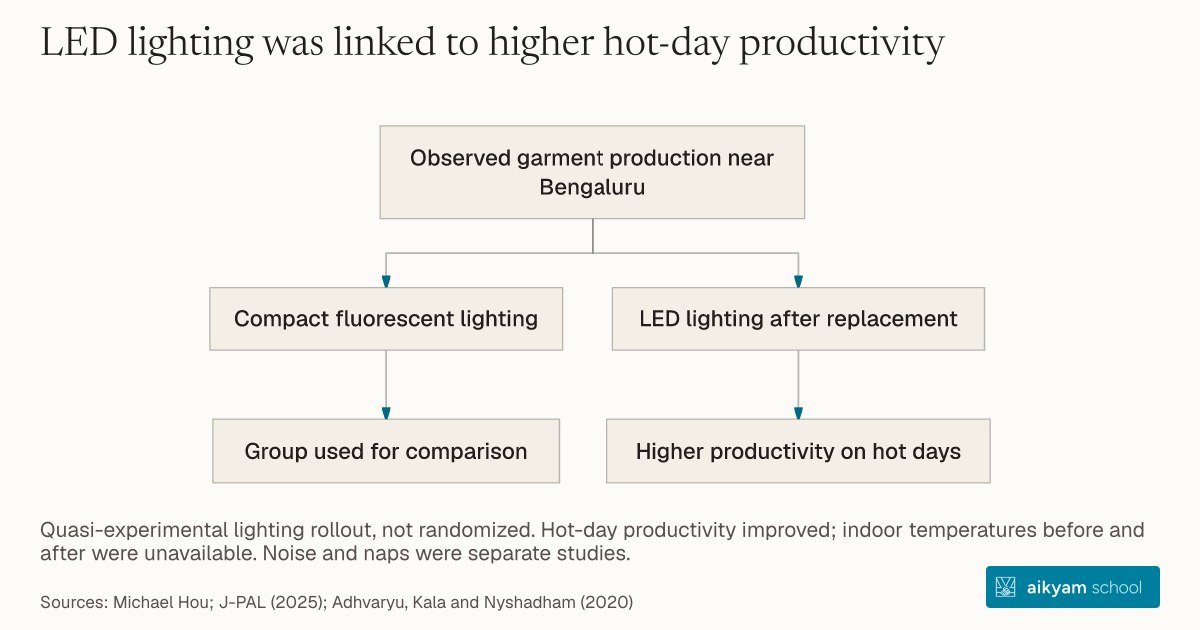
Observed garment production near Bengaluru
- Compact fluorescent lighting
- Group used for comparison
- LED lighting after replacement
- Higher productivity on hot days
Quasi-experimental lighting rollout, not randomized. Hot-day productivity improved; indoor temperatures before and after were unavailable. Noise and naps were separate studies.
See source →LED lighting study — Adhvaryu, Kala and Nyshadham ↗Research question
Adverse physical working conditions—such as excessive machinery noise, high ambient heat, poor indoor air quality, and chronic fatigue—cause cognitive impairment and physical strain in workers. These environmental stressors reduce output quality and lower daily manufacturing efficiency.
Participants
Human manufacturing line workers and call center employees exposed to ambient heat, noise, and air pollution in industrial facilities.
Study Design
Three randomized evaluations and four quasi-experimental studies evaluating low-cost physical environment modifications (LED lighting, noise reduction, afternoon naps, air quality controls) against standard factory baselines.
Results
Mitigating physical microclimates via heat-reducing LED lighting, lowering machinery noise, facilitating short afternoon naps, and reducing pollution exposure significantly increased employee cognitive function and daily labor productivity.
Takeaway
Upgrade facility lighting to heat-reducing LEDs and install acoustic dampening around heavy machinery to lower shop floor temperature and noise levels.