In Simple Words
Employment functions like opening a local community center where people gather outside their homes. Working alongside peers gives women a safe environment to swap advice, share health experiences, and learn about family planning options from each other.
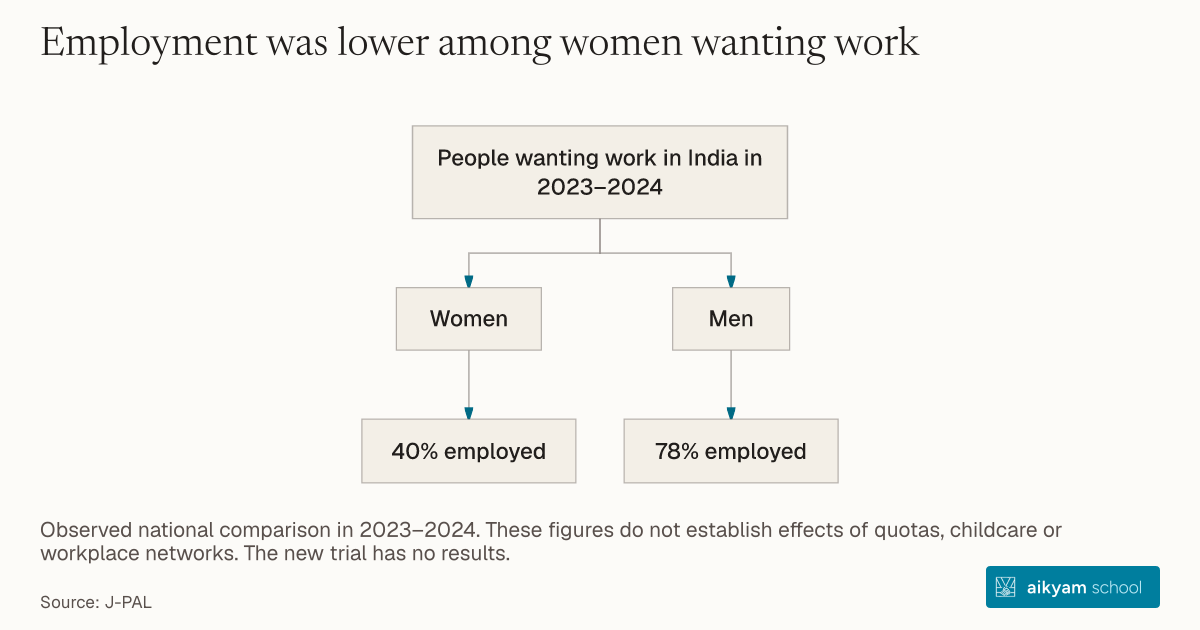
People wanting work in India in 2023–2024
- Women
- 40% employed
- Men
- 78% employed
Observed national comparison in 2023–2024. These figures do not establish effects of quotas, childcare or workplace networks. The new trial has no results.
See source →Research question
Rural women often experience severe social isolation within the home, limiting their access to peer support and information required to navigate family planning and contraceptive choices.
Participants
9,600 households across 480 Gram Panchayats in Madhya Pradesh, India.
Study Design
Clustered RCT evaluating direct public employment access, peer network exposure, and downstream reproductive decisions.
Results
Baseline state survey revealed 40% female employment compared to 78% male employment; evaluation measures whether job expansion builds social networks that make family planning accessible and affordable.
Takeaway
Design female-focused public employment projects to foster peer networking and informal knowledge sharing on reproductive health.
Source and citation
See source →Read alongside the research
Plain-English glossary
Original explanations, informed by the references below. Examples are illustrations, not data from the studies above. The research text stays unchanged.
- Baseline
The starting measurements in a study. Researchers use these to compare what participants were like at the start with what happens later.
ExampleBefore a training programme starts, researchers measure workers’ earnings. That first measurement is the baseline.
GET-IT glossary · Baseline characteristics ↗Read more about baseline →- Randomized controlled trial
A study that uses chance, like drawing lots, to decide who receives each option being compared. Researchers compare the groups’ outcomes to estimate the effect of those options.
ExampleA lottery assigns volunteers to a training programme or a comparison group. Researchers then compare their outcomes.
GET-IT glossary · Randomized study ↗Read more about randomized controlled trial →