Research design
Compare accuracy-linked survey payments
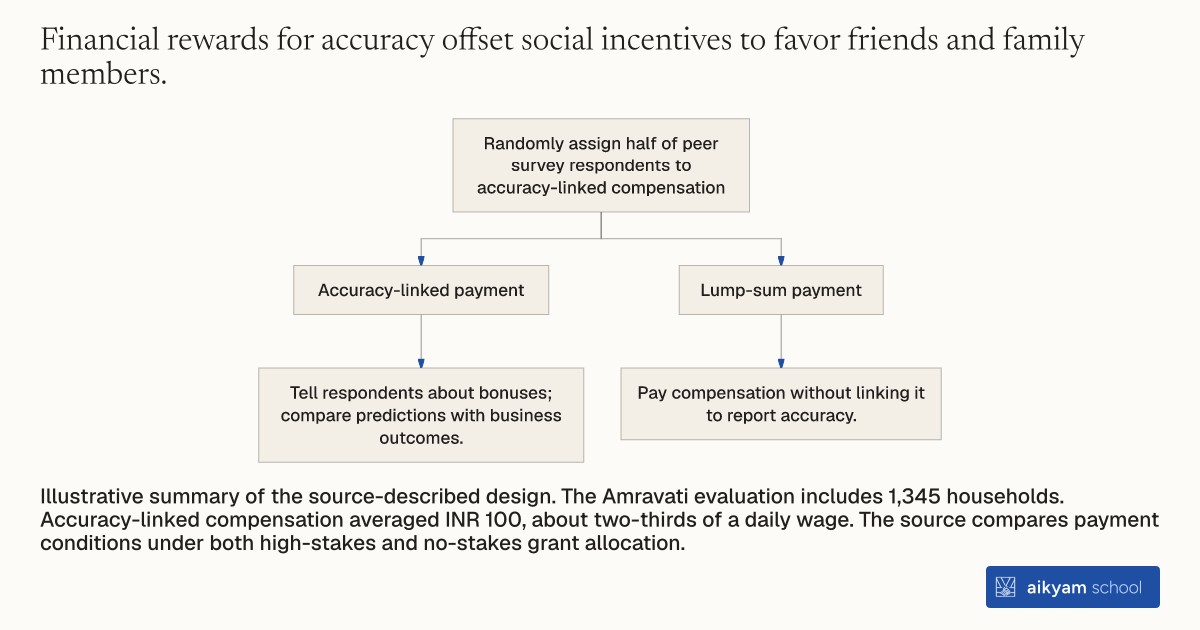
Randomly assign half of peer survey respondents to accuracy-linked compensation
- Accuracy-linked payment
- Tell respondents about bonuses; compare predictions with business outcomes.
- Lump-sum payment
- Pay compensation without linking it to report accuracy.
Illustrative summary of the source-described design. The Amravati evaluation includes 1,345 households. Accuracy-linked compensation averaged INR 100, about two-thirds of a daily wage. The source compares payment conditions under both high-stakes and no-stakes grant allocation.
See source →How
When to use
Survey respondents distort peer ranking assessments in favor of family and friends when high financial resources or grants are at stake. Traditional lump-sum survey payments fail to counter social obligations or nepotism during information gathering. Offering respondents financial compensation calibrated to survey report accuracy aligns personal incentives with truthful disclosure.
Offer survey respondents accuracy-calibrated monetary bonuses during peer evaluation interviews to encourage truthful reporting.
- Design survey protocols that calibrate respondent compensation based on the objective accuracy of peer assessment reports.
- Set target incentive payouts equal to roughly two-thirds of the local daily wage to make accuracy financially meaningful.
- Inform survey respondents prior to interview completion that reporting true beliefs yields an additional monetary bonus.
- Compare respondent predictions against verified business performance metrics to calculate individual report accuracy.
- Disburse accuracy-calibrated financial bonuses to respondents whose reports match actual baseline and follow-up business outcomes.
Why it works
Aligning financial compensation directly with truthfulness realigns respondent self-interest with accurate information sharing.
Example
Researchers in Amravati, India offered half of 1,345 microentrepreneurs an accuracy-calibrated compensation averaging 100 Indian rupees (1.70 US dollars, or two-thirds of average daily wage) for peer ranking surveys, while others received a lump-sum payment. Accuracy-calibrated payments improved report accuracy by over 100 percent under high-stakes conditions.
About the study
Participants
1,345 households across nine peri-urban neighborhoods organized into 274 peer groups of five in Amravati, Maharashtra, India.
Study Design
Randomized evaluation assigning half of peer survey respondents to receive accuracy-calibrated payments of INR 100 versus lump-sum compensation across high-stakes and no-stakes grant allocation treatments.
Results
Monetary payments for accuracy doubled reporting accuracy under no-stakes conditions and improved reporting accuracy by over 100 percent under high-stakes conditions.