Research steps
Compare patrol records and assignments
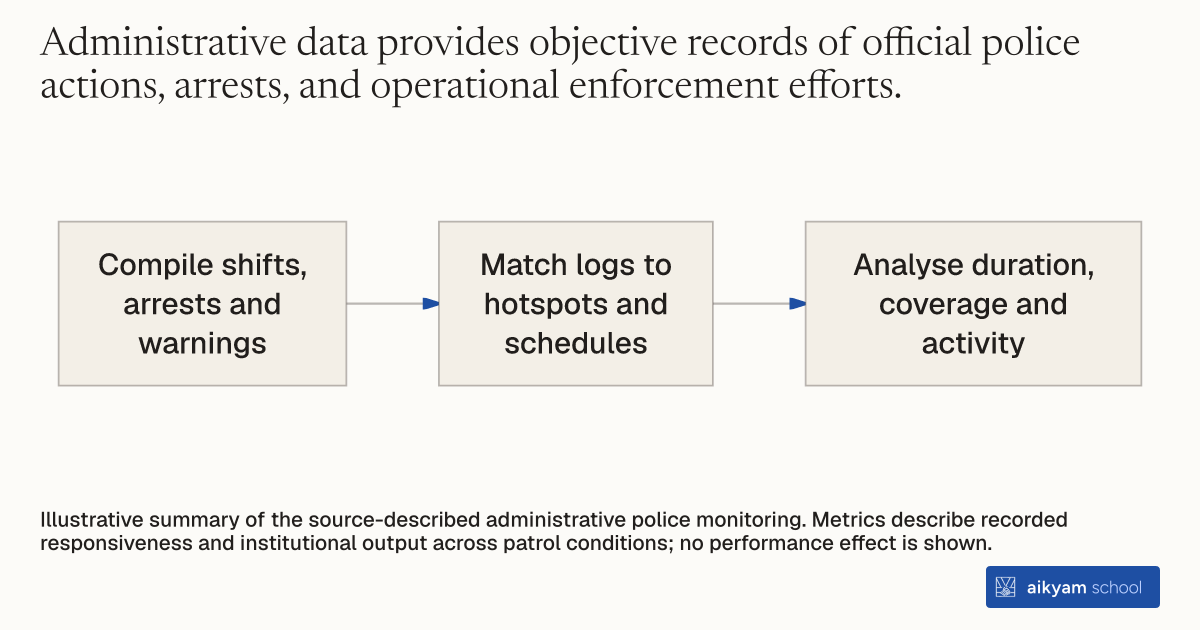
- Compile shifts, arrests and warnings
- Match logs to hotspots and schedules
- Analyse duration, coverage and activity
Illustrative summary of the source-described administrative police monitoring. Metrics describe recorded responsiveness and institutional output across patrol conditions; no performance effect is shown.
See source →How
When to use
Evaluating public safety programs requires tracking officer performance and operational activities alongside field observations. Relying solely on external survey data omits internal police actions and administrative efficiency metrics. Track administrative police data to measure officer performance and evaluate institutional responses during public patrolling programs.
Track administrative law enforcement records to evaluate police performance and operational activity across assigned patrol zones.
- Access official police administrative databases tracking officer deployments, shift logs, and patrol assignments.
- Compile administrative records on arrests, formal warnings, and perpetrator processing across target hotspots.
- Cross-reference administrative police data with assigned patrolling schedules and hotspot classifications.
- Monitor officer activity logs to verify patrol duration and coverage across assigned public spaces.
- Analyze administrative performance metrics to assess police responsiveness and institutional output across patrol conditions.
Why it works
Combining administrative metrics with field observations provides a complete picture of institutional police performance.
Example
Researchers used administrative police data from the Hyderabad City Police in Hyderabad, India, to track officer performance and activity across 350 public hotspots during a randomized evaluation.
About the study
Participants
350 hotspots in Hyderabad, India.
Study Design
Analysis of administrative police data alongside field enumerator tracking across 100 uniformed patrol, 100 undercover patrol, and 150 comparison hotspots.
Results
Administrative police data monitoring complemented field observation, showing that uniformed patrols achieved a 27 percent reduction in severe sexual harassment (0.7 fewer women harassed per week per hotspot).