Research records
Track both randomly assigned groups
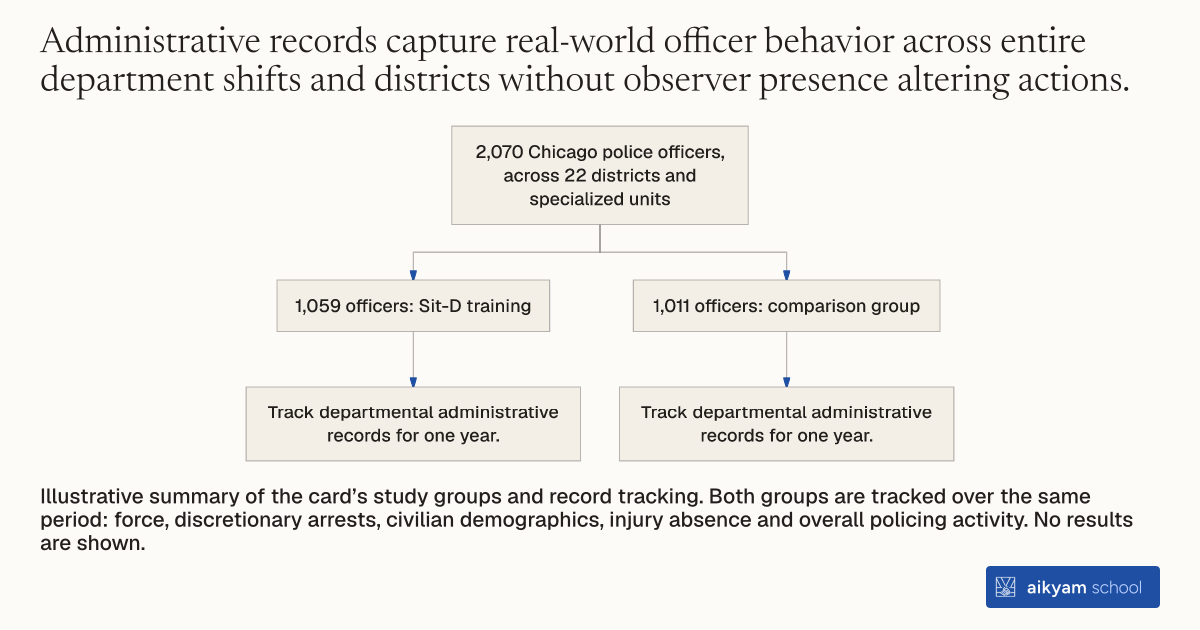
2,070 Chicago police officers, across 22 districts and specialized units
- 1,059 officers: Sit-D training
- Track departmental administrative records for one year.
- 1,011 officers: comparison group
- Track departmental administrative records for one year.
Illustrative summary of the card’s study groups and record tracking. Both groups are tracked over the same period: force, discretionary arrests, civilian demographics, injury absence and overall policing activity. No results are shown.
See source →How
When to use
Adverse policing practices like excessive force and unnecessary arrests harm communities and cause costly officer injuries. Departmental oversight requires tracking actual field behavior rather than relying solely on self-reports or lab exercises. This method uses police administrative records to track use of force, discretionary arrests, and injury-related absences over time.
Track field policing outcomes and officer injuries using departmental administrative databases over an evaluation period.
- Evaluators aggregate administrative records of nonlethal use of force incidents per officer per month.
- Researchers extract records of discretionary arrests such as disorderly conduct or disobeying police commands.
- Evaluators record subject demographic information for each arrest to measure impacts across racial groups.
- Researchers log total monthly officer injury-related absence days from department personnel files.
- Evaluators track general policing activity levels to verify that officers maintain overall duty actions.
Why it works
Comparing these records across randomized groups isolates the actual field impacts of training interventions on force, arrests, and officer safety.
Example
Researchers tracked administrative records for 2,070 Chicago police officers across all 22 districts over one year following Sit-D training or control assignments. Records showed trained officers reduced nonlethal force by 23 percent, cut discretionary arrests by 23 percent, decreased arrests of Black civilians by 28 percent, and reduced injury absence days by nearly 50 percent.
About the study
Participants
2,070 eligible police officers with two or more years of service from all 22 Chicago Police Department districts and specialized units, randomly assigned to 1,059 treatment officers and 1,011 comparison officers.
Study Design
Randomized controlled trial tracking officer field actions through police administrative data over a one-year post-training period.
Results
Trained officers reduced nonlethal force from 38.12 to 29.25 incidents per 1,000 officers per month, discretionary arrests from 36.85 to 28.38 per 1,000 officers per month, discretionary arrests of Black civilians from 31.26 to 22.41 per 1,000 officers per month, and injury-related absence days from 1.179 to 0.607 days per month.