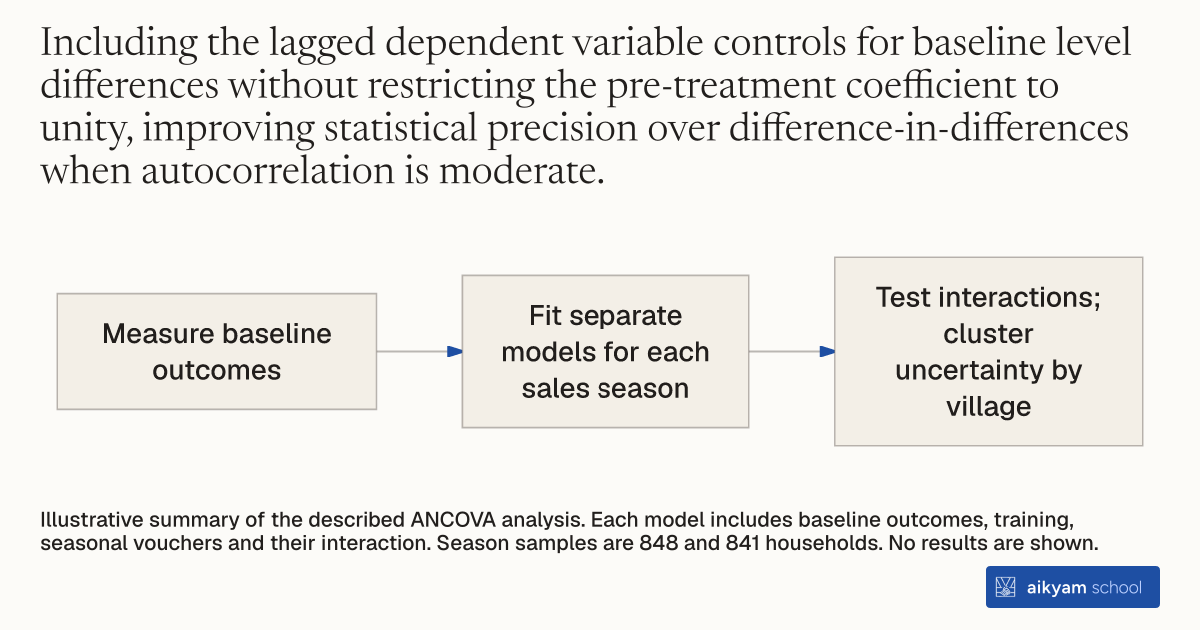
Research steps
Analyse training and vouchers by sales season
- Measure baseline outcomes
- Fit separate models for each sales season
- Test interactions; cluster uncertainty by village
Illustrative summary of the described ANCOVA analysis. Each model includes baseline outcomes, training, seasonal vouchers and their interaction. Season samples are 848 and 841 households. No results are shown.
See source →How
When to use
Combining baseline interventions with cross-round re-randomized treatments can introduce statistical noise and inefficiency in standard difference-in-differences models. Analysis of covariance controls for baseline outcome variation by incorporating lagged dependent variables alongside interaction terms. This method provides superior statistical power when evaluating single-period treatment effects and treatment interactions.
Estimate single-period intervention impacts and treatment interactions using an analysis of covariance specification with lagged baseline dependent variables.
- Measure baseline household outcomes prior to treatment delivery across all experimental study arms.
- Structure cross-sectional regression models separately for each post-treatment sales wave.
- Include dummy variables for baseline interventions, seasonal treatments, and their interaction term in the regression specification.
- Add the lagged baseline outcome variable as a linear covariate to absorb baseline outcome variance.
- Estimate regression coefficients using ordinary least squares with standard errors clustered at the village level.
- Test interaction coefficients to evaluate whether baseline promotional training enhances seasonal subsidy responses.
Why it works
Estimating separate analysis of covariance equations per sales season accounts for time-varying treatment interaction effects across sales rounds.
Example
Researchers analyzed the interaction between baseline educational training and seasonal discount vouchers across 848 farming households in Amhara, Ethiopia, finding that training increased first-season voucher uptake by 11 percentage points.
About the study
Participants
848 cooperative farming households in sales season 1 and 841 households in sales season 2 across 49 villages in Amhara Region, Ethiopia.
Study Design
Round-by-round analysis of covariance estimation incorporating baseline outcome variables, baseline training dummies, seasonal voucher dummies, and interaction terms, with standard errors clustered at the village level.
Results
Combined baseline training and vouchers increased first-season insurance coverage by an additional 11 percentage points (p < 0.05), but produced no statistically significant interactive improvements in chemical fertilizer adoption (-0.0137, p > 0.1) or per capita household income (-175.3 Birr, p > 0.1).