Research steps
Use the voucher lottery to estimate uptake effects
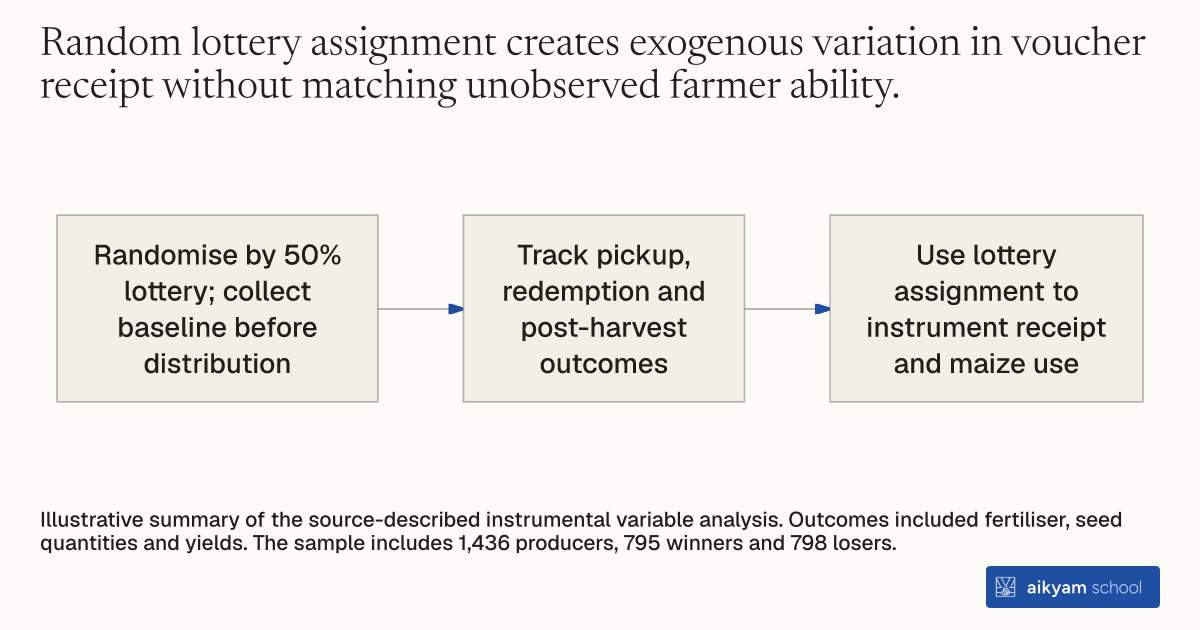
- Randomise by 50% lottery; collect baseline before distribution
- Track pickup, redemption and post-harvest outcomes
- Use lottery assignment to instrument receipt and maize use
Illustrative summary of the source-described instrumental variable analysis. Outcomes included fertiliser, seed quantities and yields. The sample includes 1,436 producers, 795 winners and 798 losers.
See source →How
When to use
Evaluating agricultural subsidy programs using raw treatment assignment creates small impact estimates when voucher compliance is low. Standard models average results across non-compliant winners, hiding the true benefits for actual adopters. This method isolates the true effect of input uptake on active participants by using random lottery winning as an instrumental variable.
Estimate the true local average treatment effect of voucher adoption by using randomized lottery winning as an instrumental variable for coupon receipt and usage.
- Assign eligible smallholders to treatment or control status using a village-level 50% random lottery.
- Collect baseline survey data on demographics, prior input usage, and land holdings before voucher distribution.
- Track actual voucher receipt, pickup rates, and redemption for target crops across treatment and control groups during the planting season.
- Conduct post-harvest follow-up surveys to measure fertilizer application, seed quantities, and crop yields for all lottery participants.
- Estimate instrumental variable regressions using lottery assignment to instrument for voucher receipt and active voucher usage on target crops.
Why it works
Instrumental variable estimation isolates the local average treatment effect, showing the true productivity gain among compliant farmers who adopt inputs.
Example
In Manica Province, Mozambique, researchers used a 50% voucher lottery as an instrument to measure input uptake among 1,436 smallholder maize producers. While intention-to-treat estimates showed a 14.8 kg increase in fertilizer use per lottery winner, the instrumental variable estimate proved that using the voucher for maize increased fertilizer application by 68.3 kg and improved seed use by 14.4 kg.
About the study
Participants
N = 1,436 smallholder maize producers (795 treatment group lottery winners, 798 control group lottery losers) across 75 villages in Manica Province, Mozambique; sample household heads were 84% male and 76% literate.
Study Design
Randomized Controlled Trial (RCT) using village-level lottery winning as an instrument for voucher receipt and active voucher usage in Instrumental Variable (IV) regressions.
Results
Instrumental variable estimates showed that voucher receipt increased fertilizer application by 39 kilograms and improved seed use by 8.1 kilograms; using the voucher specifically for maize increased fertilizer application by 68.3 kilograms (p < 0.01) and improved seed use by 14.4 kilograms (p < 0.01).