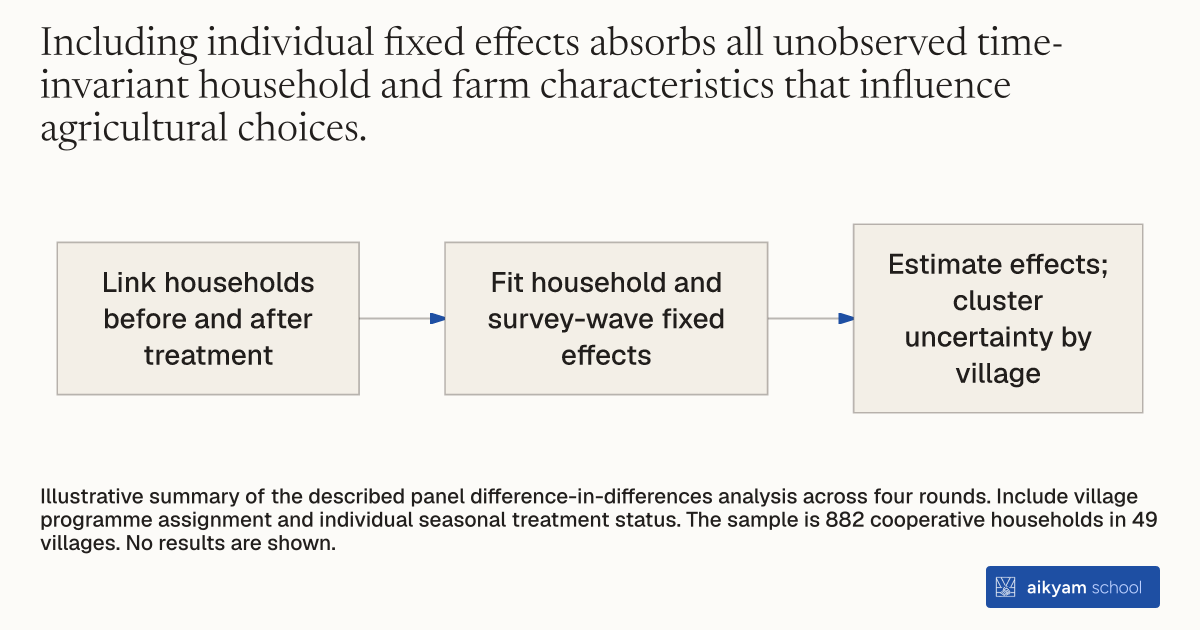
Research steps
Compare agricultural outcomes across survey rounds
- Link households before and after treatment
- Fit household and survey-wave fixed effects
- Estimate effects; cluster uncertainty by village
Illustrative summary of the described panel difference-in-differences analysis across four rounds. Include village programme assignment and individual seasonal treatment status. The sample is 882 cooperative households in 49 villages. No results are shown.
See source →How
When to use
Evaluating the impact of multi-period agricultural interventions requires controlling for time-invariant household heterogeneity and seasonal trends. Simple cross-sectional comparisons suffer from omitted variable bias and baseline imbalance. Panel fixed-effects difference-in-differences regression isolates treatment impacts across longitudinal survey rounds.
Estimate intervention impacts on agricultural outcomes using panel fixed-effects difference-in-differences regressions.
- Collect panel survey data on household input use, agricultural yields, and income across pre-treatment and post-treatment survey waves.
- Structure the dataset as a multi-period panel linked by unique household identification numbers.
- Define dummy variables indicating village-level program assignment and individual-level seasonal treatment status.
- Specify a linear regression model including individual household fixed effects and post-treatment survey wave fixed effects.
- Estimate treatment impact coefficients on targeted outcome variables across all post-treatment rounds.
- Cluster standard errors at the village level to adjust for spatial design effects and intra-cluster correlation.
Why it works
Wave fixed effects control for macro-level seasonal shifts, ensuring that estimated treatment coefficients capture true intervention effects.
Example
Researchers evaluated the impact of index insurance vouchers across 882 cooperative households in Amhara, Ethiopia, using household fixed-effects difference-in-differences regressions clustered at the village level.
About the study
Participants
882 panel cooperative farming households across 49 villages in Amhara Region, Ethiopia, tracked across 4 survey rounds.
Study Design
Panel fixed-effects difference-in-differences regression model including household and wave fixed effects with standard errors clustered at the village level.
Results
Voucher assignment increased index insurance coverage by 35.6 percentage points (p < 0.01), but showed no significant impact on chemical fertilizer adoption (+3.1 percentage points, p > 0.1), chemical fertilizer quantity (-4.64 kg, p > 0.1), or yield index (-0.02 SD, p > 0.1).