Research description
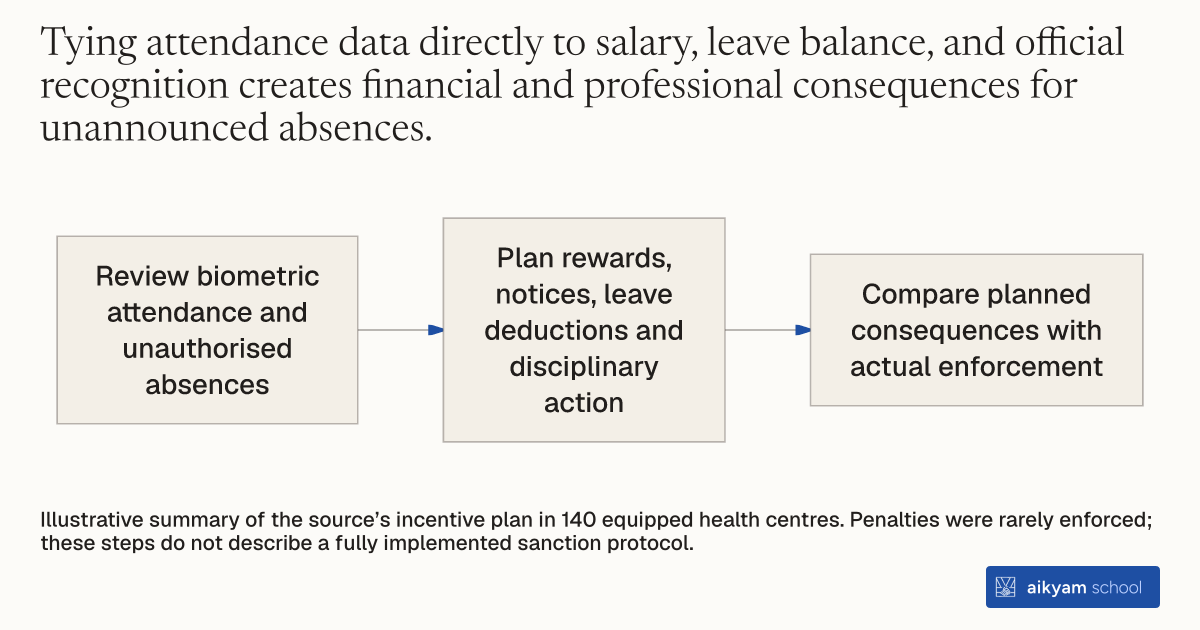
Describe planned attendance consequences
- Review biometric attendance and unauthorised absences
- Plan rewards, notices, leave deductions and disciplinary action
- Compare planned consequences with actual enforcement
Illustrative summary of the source’s incentive plan in 140 equipped health centres. Penalties were rarely enforced; these steps do not describe a fully implemented sanction protocol.
See source →How
When to use
Public health authorities face high employee absenteeism when paper records let supervisors hide absences without consequence. Unannounced absences reduce health service delivery in primary health centers. This method links recorded biometric attendance data to positive staff rewards and official leave balance deductions.
Link objective biometric attendance records to positive rewards and salary deductions for primary health center workers.
- Analyze daily biometric attendance data received at state health headquarters.
- Issue positive incentives such as public rewards to health center staff members with good attendance records.
- Review unauthorized absences among health center staff members after guaranteed leave days are depleted.
- Issue formal reprimand letters and notices to staff members with unauthorized absences requiring explanation.
- Deduct unauthorized absences directly from the employee's accrued earned leave balance.
- Enforce disciplinary actions, docking of pay, or service suspension for persistent unauthorized absences.
Why it works
It removes supervisor leniency by establishing clear state-level administrative rules for provider attendance.
Example
In Karnataka, the state government planned to use attendance data from 140 primary health centers to issue rewards for good attendance and dock pay or deduct leave for unauthorized absences, though official penalties were rarely enforced in practice.
About the study
Participants
322 primary health centers across five socio-economically diverse districts in Karnataka, India, covering healthcare providers including doctors, nurses, lab technicians, and pharmacists.
Study Design
Randomized controlled trial comparing 140 health centers where attendance data was linked to official incentive and penalty structures against 182 health centers with standard paper logbooks.
Results
Government health officers rarely enforced leave deductions or formal notices due to complex inter-agency coordination. Non-doctor medical staff attendance still increased by 7 percentage points from a 40 percent baseline, whereas doctor attendance remained unchanged at 36 percent.