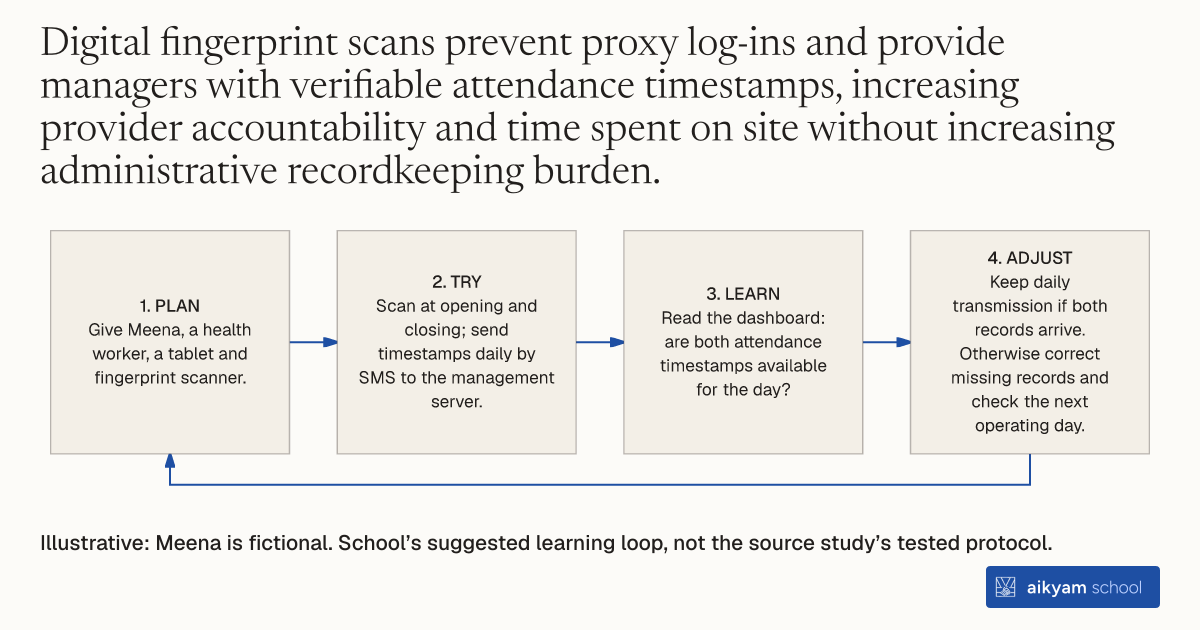
Try, learn and adjust
Check opening and closing attendance records
- Plan: Give Meena, a health worker, a tablet and fingerprint scanner.
- Try: Scan at opening and closing; send timestamps daily by SMS to the management server.
- Learn: Read the dashboard: are both attendance timestamps available for the day?
- Adjust: Keep daily transmission if both records arrive. Otherwise correct missing records and check the next operating day.
Illustrative: Meena is fictional. School’s suggested learning loop, not the source study’s tested protocol.
See source →School’s suggested, untested loop: observe provider login and logout records and time at the centre.
How
When to use
In primary healthcare delivery programs with decentralized centers, monitoring health worker presence and daily effort is difficult due to reliance on paper registers. Health workers may spend limited time at clinics or neglect patient follow-up. Biometric login monitoring requires health workers to scan their fingerprints when opening and closing clinic operations to track attendance and presence in real time.
Require health workers to authenticate their identity using biometric scanners upon opening and closing care facilities each day.
- Issue health workers a mobile tablet connected to a fingerprint scanner.
- Require health workers to scan their fingerprint when logging in at the start of operating hours and logging out at the end.
- Transmit biometric login timestamps daily via SMS to a central management server.
- Allow program managers to view provider attendance and time spent at centers in real-time dashboards.
- Use tracked attendance records to enforce managerial oversight and evaluate health worker effort.
Example
Operation ASHA deployed biometric login tracking across 34 tuberculosis centers in urban informal settlements in India, increasing provider attendance at centers by 12 percent and daily time spent at clinics by 19 percent compared to 31 unmonitored centers.
About the study
Participants
65 OpASHA catchment areas serving urban informal settlements across four states in Northern India, each serving nearly 40,000 individuals and managed by one health worker.
Study Design
Randomized controlled trial across 65 catchment areas (34 treatment and 31 control), evaluating provider performance through unannounced spot visits, patient surveys, administrative registers, and day-long clinic observations over 12 to 14 months.
Results
Biometric login monitoring increased provider attendance at centers by 7.1 percentage points (12 percent) from 59.8 percent to 66.9 percent, increased time spent at centers by 22.3 minutes per day (19 percent) from 117.3 to 139.6 minutes, and increased the frequency of home visits to patients missing doses by 32 percent.