Try, learn and adjust
Check weekly rewards for daily walking
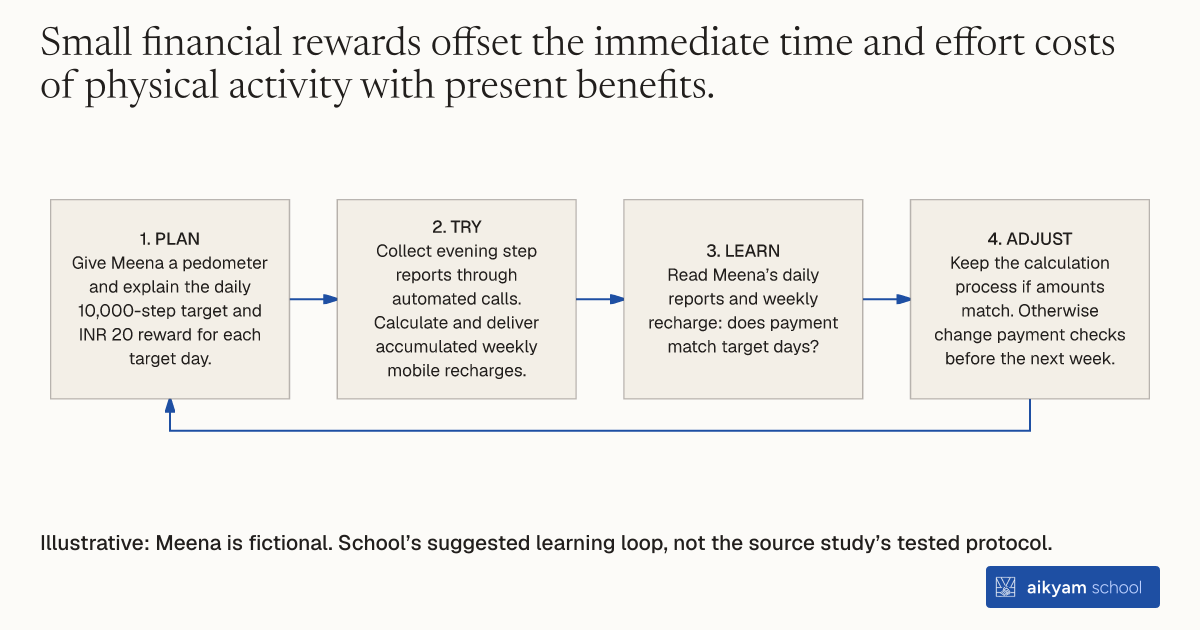
- Plan: Give Meena a pedometer and explain the daily 10,000-step target and INR 20 reward for each target day.
- Try: Collect evening step reports through automated calls. Calculate and deliver accumulated weekly mobile recharges.
- Learn: Read Meena’s daily reports and weekly recharge: does payment match target days?
- Adjust: Keep the calculation process if amounts match. Otherwise change payment checks before the next week.
Illustrative: Meena is fictional. School’s suggested learning loop, not the source study’s tested protocol.
See source →School’s suggested, untested loop: observe step reports, target days and weekly recharges; do not infer health gains.
How
When to use
Urban adults managing chronic lifestyle conditions like diabetes often put off regular exercise because present effort costs outweigh distant health benefits. Providing simple, weekly financial rewards for meeting daily step targets creates immediate motivation to increase physical activity. This method serves urban diabetics and pre-diabetics who need ongoing reinforcement to sustain walking routines.
Reward participants on a weekly basis for each individual day they achieve a target step count.
- Issue pedometers to program participants to monitor daily walking progress.
- Set a daily physical activity goal of 10,000 steps.
- Collect daily step reports every evening through an automated calling system.
- Calculate weekly rewards at a rate of INR 20 (US\$0.33) for each day the step target is achieved.
- Deliver total accumulated weekly reward payments via mobile recharges.
Why it works
Weekly payments provide consistent, recurring positive reinforcement that helps individuals turn exercise into a habit.
Example
In Tamil Nadu, India, researchers offered urban diabetics and pre-diabetics INR 20 (US\$0.33) for each day they walked 10,000 steps, paid out weekly via mobile recharges over twelve weeks. Participants in incentive groups met the daily target on 49 percent of days compared to 29 percent in the monitoring group, taking 1,270 additional steps per day.
About the study
Participants
3,192 urban diabetics and pre-diabetics in Tamil Nadu, India; average age almost 50 years; 58 percent male.
Study Design
Randomized controlled trial comparing a weekly base incentive contract against a monitoring-only control group over 12 weeks.
Results
Participants receiving incentives reached the target on 49 percent of days compared to 29 percent for monitoring controls, increasing daily walking by 1,270 steps from a baseline of 6,770 steps.