Research procedure
Compare beliefs and behaviour
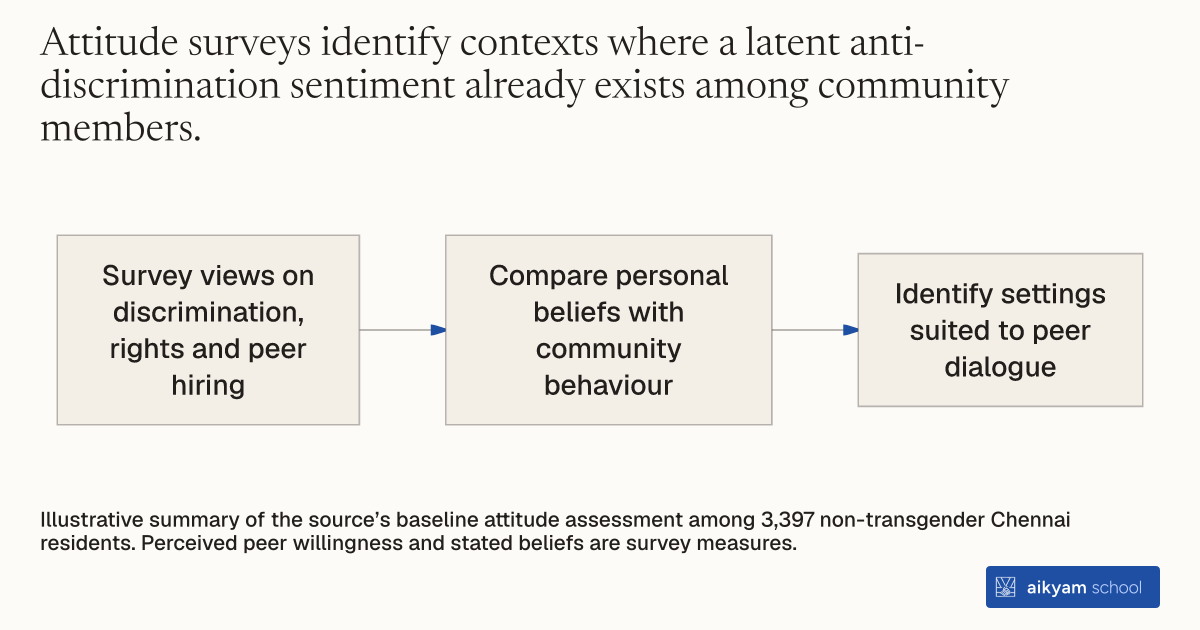
- Survey views on discrimination, rights and peer hiring
- Compare personal beliefs with community behaviour
- Identify settings suited to peer dialogue
Illustrative summary of the source’s baseline attitude assessment among 3,397 non-transgender Chennai residents. Perceived peer willingness and stated beliefs are survey measures.
See source →How
When to use
Organizations and researchers need to target prejudice reduction interventions in communities where social norms can be updated effectively. In many settings, discriminatory behavior is widespread even though individual community members privately believe discrimination is wrong. Administering attitude surveys allows policymakers to diagnose this gap between descriptive norms and prescriptive beliefs before deploying peer discussion programs.
Administer structured attitude surveys to assess baseline beliefs and identify gaps between personal moral stances, legal awareness, and perceived community norms.
- Survey community members on whether specific acts of discrimination against transgender individuals are right or wrong.
- Assess participant awareness regarding formal legal protections and supreme court decisions protecting transgender workers.
- Measure participant perceptions regarding how willing their neighbors and peers are to hire transgender workers.
- Compare reported individual beliefs against observed community behaviors to establish the presence of a norm disconnect.
- Select target populations demonstrating high individual condemnation of discrimination for peer dialogue interventions.
Why it works
Discovering that widespread consensus against discrimination exists provides the essential foundation for peer dialogue to correct misperceptions of neighbor intolerance.
Example
In urban Chennai, India, researchers surveyed 3,397 non-transgender participants prior to testing hiring interventions. The survey revealed that 93 percent of participants believed discrimination was wrong, while 36 percent were unaware of legal rights, identifying a strong norm disconnect suitable for peer dialogue interventions.
About the study
Participants
3,397 non-transgender urban residents in Chennai, India.
Study Design
Baseline attitude survey administered across study participants measuring individual moral stances, legal awareness, and estimated community hiring willingness.
Results
The survey revealed that 93 percent of comparison group participants described an act of discrimination as wrong, while 36 percent were unaware of supreme court legal rights.