Research procedure
Check whether hiring choices persist
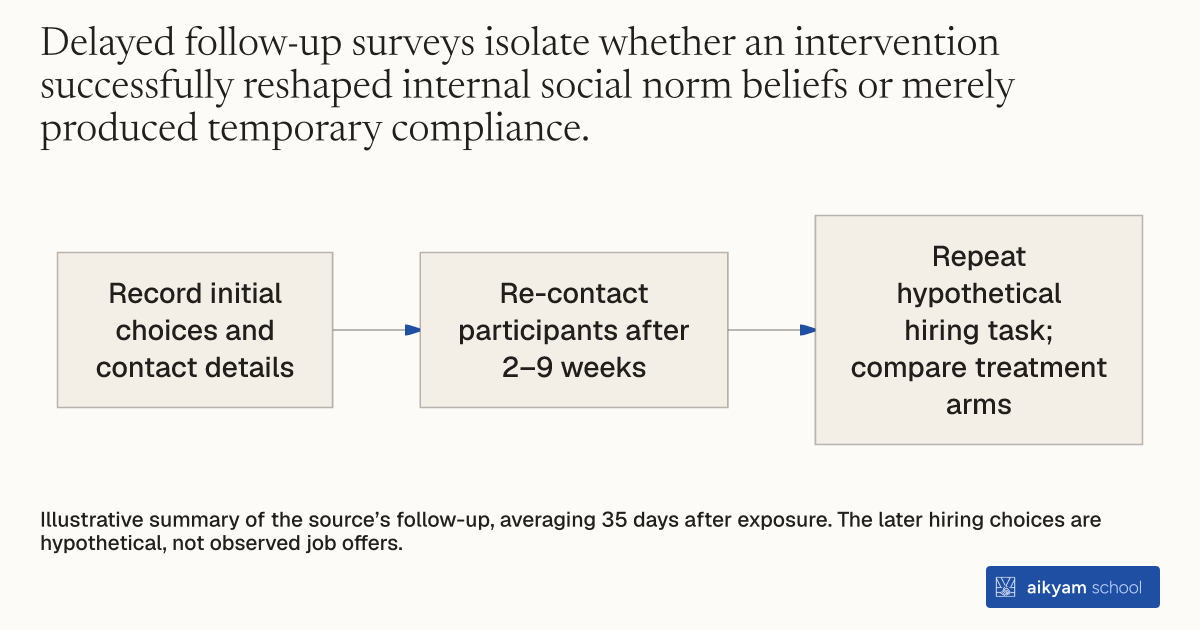
- Record initial choices and contact details
- Re-contact participants after 2–9 weeks
- Repeat hypothetical hiring task; compare treatment arms
Illustrative summary of the source’s follow-up, averaging 35 days after exposure. The later hiring choices are hypothetical, not observed job offers.
See source →How
When to use
Interventions aimed at reducing workplace discrimination against transgender individuals often demonstrate immediate short-term impact that fades rapidly over time. Evaluators and policy makers need a reliable method to distinguish temporary compliance from durable behavioral shifts. Administering delayed follow-up surveys weeks after exposure allows researchers to measure the true persistence of social norm interventions.
Re-contact program participants weeks after an intervention to measure long-term persistence of behavioral choices.
- Record participant choices and contact details during initial intervention sessions.
- Wait an average of 35 days ranging from two to nine weeks following initial treatment exposure.
- Re-contact treated and comparison group participants for a follow-up survey session.
- Present participants with hypothetical worker hiring selection tasks involving transgender candidates.
- Compare long-term selection rates between treatment arms to evaluate behavioral decay versus persistence.
Why it works
Peer group dialogue creates durable social norm updates that persist over time, whereas passive information broadcasts decay completely once immediate exposure ends.
Example
In urban Chennai, India, researchers re-surveyed 3,397 non-transgender participants an average of 35 days after initial hiring interventions. The follow-up revealed that participants in 3-person group discussions retained a 4 percentage point increase in transgender worker selection, whereas the behavioral impacts from legal rights video screenings decayed completely to zero.
About the study
Participants
3,397 non-transgender urban residents in Chennai, India.
Study Design
Longitudinal follow-up survey administered on average 35 days ranging from 2 to 9 weeks after initial randomized intervention exposure to evaluate persistent choices in a hypothetical hiring task.
Results
Participants in the 3-person discussion arm were 4 percentage points, an 11 percent increase, more likely to hire transgender individuals 2 to 9 weeks later, retaining 25 percent of short-term impact, while video treatment impacts decayed to zero.