Research procedure
Match automated polling to voter records
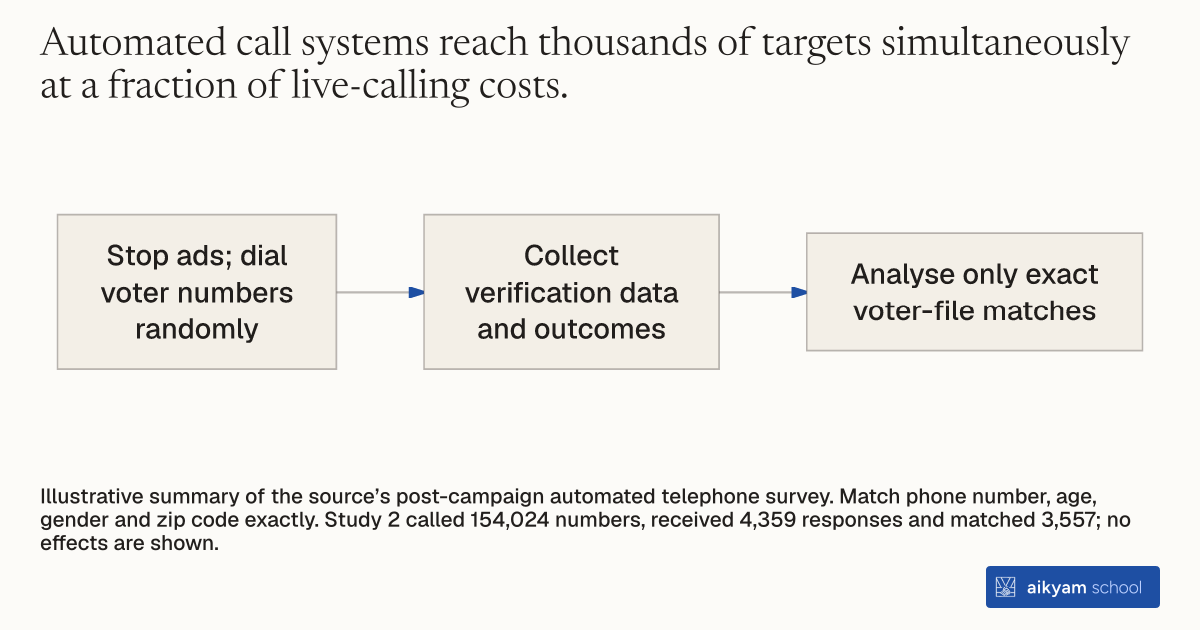
- Stop ads; dial voter numbers randomly
- Collect verification data and outcomes
- Analyse only exact voter-file matches
Illustrative summary of the source’s post-campaign automated telephone survey. Match phone number, age, gender and zip code exactly. Study 2 called 154,024 numbers, received 4,359 responses and matched 3,557; no effects are shown.
See source →How
When to use
Researchers need to poll large voter populations quickly and at low cost following an experimental campaign. Live interviewer telephone surveys can be prohibitively expensive for broad constituency studies. Automated interactive voice response polling paired with voter file matching measures campaign outcomes rapidly while verifying respondent identities.
Conduct automated interactive voice response telephone surveys immediately after campaign ad completion and match responses to public voter registration records.
- Cease all experimental advertising treatments prior to launching phone calls.
- Dial telephone numbers from targeted public voter registration lists in random order using an automated interactive voice response call system.
- Prompt respondents to enter personal verification data including age, gender, and zip code using their telephone keypads.
- Administer multiple-choice outcome questions measuring candidate impressions, issue recall, and social media platform usage.
- Filter completed survey responses by matching recorded age, gender, zip code, and telephone numbers back to public voter file entries.
- Analyze outcome data exclusively among respondents whose survey demographic entries match voter file records.
Why it works
Matching demographic entries back to public voter files verifies respondent identity and preserves experimental random assignment.
Example
In Study 2, polling firm Winning Connections called 154,024 telephone numbers on the voter file using automated IVR calls on the evening before an election, obtaining 4,359 responses and successfully matching 3,557 respondents to voter records based on phone number, age, gender, and zip code.
About the study
Participants
3,557 matched registered voters aged 18 to 64 across 8 counties in a congressional district.
Study Design
Post-campaign automated interactive voice response polling administered on a single evening, with interviewers blinded and respondents verified against voter file records.
Results
IVR polling detected a statistically significant 5.3 percentage point increase in online ad recall overall (95% CI [0.021, 0.083], p < 0.001) and an 8.1 percentage point increase among Facebook users (95% CI [0.035, 0.125], p < 0.001), but showed non-significant shifts in candidate recognition (+0.4 percentage points, 95% CI [-0.036, 0.046]) and candidate favorability (+1.1 percentage points, 95% CI [-0.028, 0.052]).