Research groups
Agree campaign rules across candidates
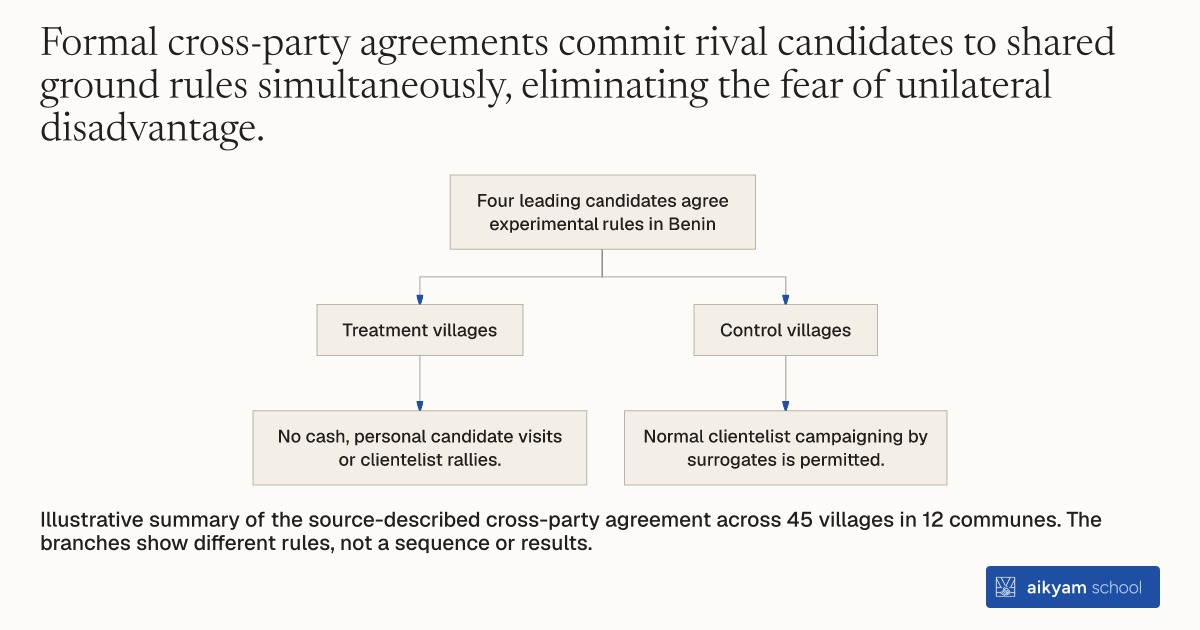
Four leading candidates agree experimental rules in Benin
- Treatment villages
- No cash, personal candidate visits or clientelist rallies.
- Control villages
- Normal clientelist campaigning by surrogates is permitted.
Illustrative summary of the source-described cross-party agreement across 45 villages in 12 communes. The branches show different rules, not a sequence or results.
See source →How
When to use
Competitive democratic elections often suffer from candidate coordination failure around campaign norms. Candidates fear losing ground if they unilaterally abandon traditional clientelist practices like gift distribution. Securing a binding formal agreement across major rival campaigns creates a shared commitments framework for testing nonclientelist platforms.
Establish a formal campaign agreement among major competing political candidates to abide by experimental campaign protocols in designated electoral districts.
- Invite all major presidential candidates and their campaign leadership to participate in a joint research effort.
- Negotiate an explicit agreement outlining campaign rules and restrictions for treatment and control villages.
- Designate specific geographic communes where each participating campaign agrees to run experimental town hall campaigns.
- Enforce strict restrictions prohibiting cash distributions, personal candidate visits, and clientelist rallies in assigned treatment villages.
- Permit normal clientelist campaign practices by campaign surrogates in assigned control villages.
Why it works
Supervision by an independent research institute ensures candidates adhere to agreed campaign restrictions.
Example
In Benin ahead of the 2006 presidential election, four leading candidates representing 85 percent of the national vote entered a formal agreement with the Beninese Institute for Empirical Research in Political Economy (IERPE). The candidates agreed to replace festive clientelist rallies with expert-led deliberative town halls in randomly selected villages across 12 communes while maintaining standard campaign rallies in control villages.
About the study
Participants
4 presidential candidate campaign teams in Benin, testing protocols across 45 villages in 12 communes representing under 2 percent of the national electorate.
Study Design
Randomized field experiment with campaign protocol compliance monitored by independent research staff across treatment and control villages.
Results
Candidates adhered strictly to the agreement, resulting in a 0.227 standard deviation drop in the clientelism index in treatment villages and a 16.8 percentage point vote increase for non-dominant candidates outside their strongholds.