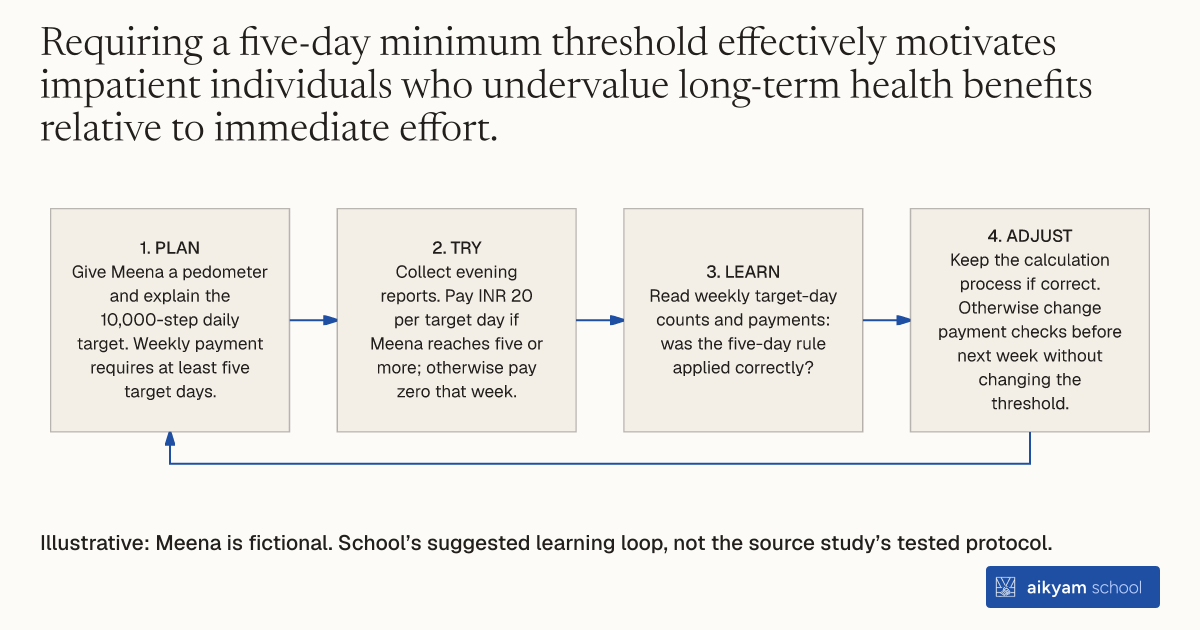
Try, learn and adjust
Check five-day threshold payments
- Plan: Give Meena a pedometer and explain the 10,000-step daily target. Weekly payment requires at least five target days.
- Try: Collect evening reports. Pay INR 20 per target day if Meena reaches five or more; otherwise pay zero that week.
- Learn: Read weekly target-day counts and payments: was the five-day rule applied correctly?
- Adjust: Keep the calculation process if correct. Otherwise change payment checks before next week without changing the threshold.
Illustrative: Meena is fictional. School’s suggested learning loop, not the source study’s tested protocol.
See source →School’s suggested, untested loop: observe target days, weekly eligibility and weekly payments; no walking gain is assumed.
How
When to use
Urban health programs encouraging regular physical activity face budget constraints when paying for sporadic exercise. Setting a strict five-day weekly threshold conditions financial rewards on consistent goal achievement. This method serves urban diabetics and pre-diabetics who need strong weekly commitment targets to maintain daily walking habits.
Condition financial reward payouts on participants achieving daily step targets on at least five days within a given week.
- Distribute pedometers to program participants to monitor daily walking progress.
- Establish a daily physical activity target of 10,000 steps or more.
- Collect daily step count reports every evening through an automated calling system.
- Count the total number of days within the week that the step target was met.
- Pay INR 20 (US\$0.33) for each target day on a weekly basis if the target was met on five or more days.
- Issue zero payment for the week if the participant met the target on fewer than five days.
Why it works
It also improves cost-effectiveness by withholding payments from participants who walk on only a few days per week.
Example
In Tamil Nadu, India, researchers offered urban diabetics and pre-diabetics INR 20 (US\$0.33) per successful day if they met the 10,000-step target on at least five days of a week. This five-day threshold contract reduced total payout costs by 15 percent compared to base incentives (costing INR 17 versus INR 20 per target day) while spurring the same amount of walking.
About the study
Participants
3,192 urban diabetics and pre-diabetics in Tamil Nadu, India; average age almost 50 years; 58 percent male.
Study Design
12-week randomized controlled trial evaluating threshold incentive contracts against base incentives and monitoring controls.
Results
The five-day threshold contract reduced total payout costs by 15 percent compared to base incentives (averaging INR 17 per target day instead of INR 20) while generating equivalent walking increases.