Try, learn and adjust
Check mobile recharge payments
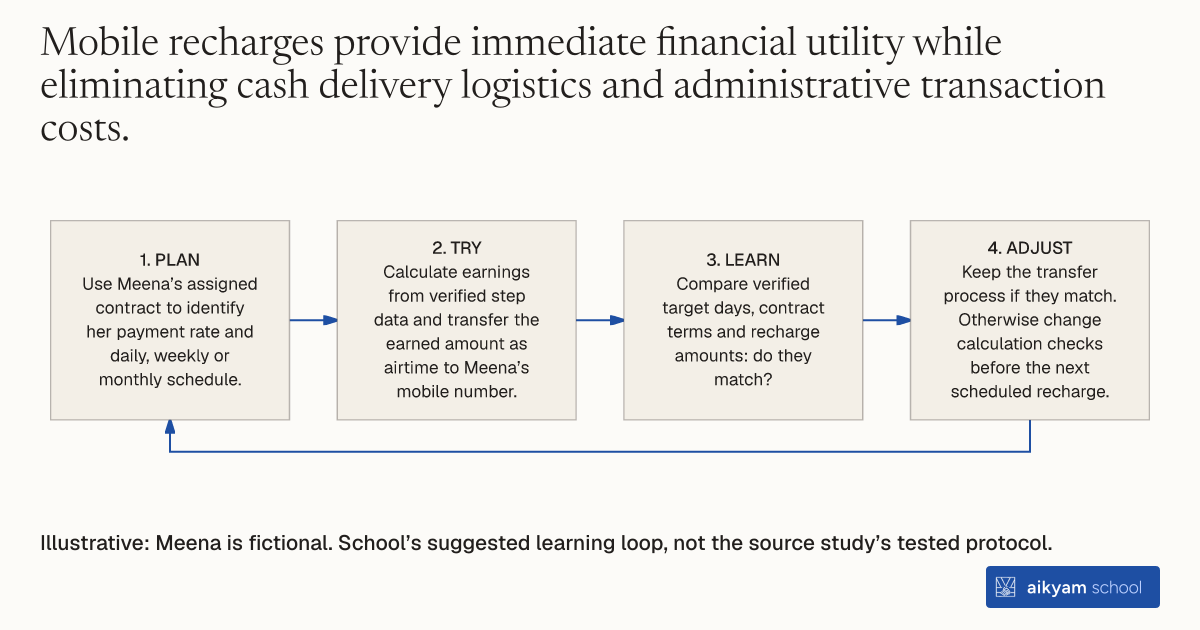
- Plan: Use Meena’s assigned contract to identify her payment rate and daily, weekly or monthly schedule.
- Try: Calculate earnings from verified step data and transfer the earned amount as airtime to Meena’s mobile number.
- Learn: Compare verified target days, contract terms and recharge amounts: do they match?
- Adjust: Keep the transfer process if they match. Otherwise change calculation checks before the next scheduled recharge.
Illustrative: Meena is fictional. School’s suggested learning loop, not the source study’s tested protocol.
See source →School’s suggested, untested loop: observe verified data, earned amounts and scheduled recharges; this does not isolate recharge effects.
How
When to use
Health programs providing small monetary rewards across large populations need a frictionless, low-cost mechanism to deliver payments. Transferring monetary incentives directly as mobile phone airtime recharges distributes financial rewards without cash handling costs or physical distribution. This method serves urban populations managing chronic conditions like diabetes in developing markets.
Distribute small financial incentive payments directly to participants' mobile phone accounts as airtime recharges upon meeting targets.
- Collect daily verified step data submitted by participants through phone calls or tracking devices.
- Calculate earned financial incentive payments based on participant contract structures.
- Initiate digital airtime top-ups to participants' mobile phone numbers equivalent to earned reward amounts.
- Deliver mobile recharges on daily, weekly, or monthly schedules corresponding to treatment contracts.
Why it works
Using mobile airtime top-ups delivers monetary value directly to participants' personal devices in a seamless digital process.
Example
In Tamil Nadu, India, researchers delivered small financial rewards ranging from INR 10 to INR 20 (US\$0.17 to US\$0.33) per target day directly via mobile phone recharges to urban diabetics and pre-diabetics over twelve weeks, boosting daily physical activity by 1,270 steps.
About the study
Participants
3,192 urban diabetics and pre-diabetics in Tamil Nadu, India; average age almost 50 years; 58 percent male.
Study Design
Randomized controlled trial delivering daily, weekly, or monthly incentive payments via mobile recharges over 12 weeks.
Results
Delivering rewards via mobile recharges led participants across incentive groups to meet 10,000-step targets on 49 percent of days compared to 29 percent for controls, adding 1,270 daily steps.