Research steps
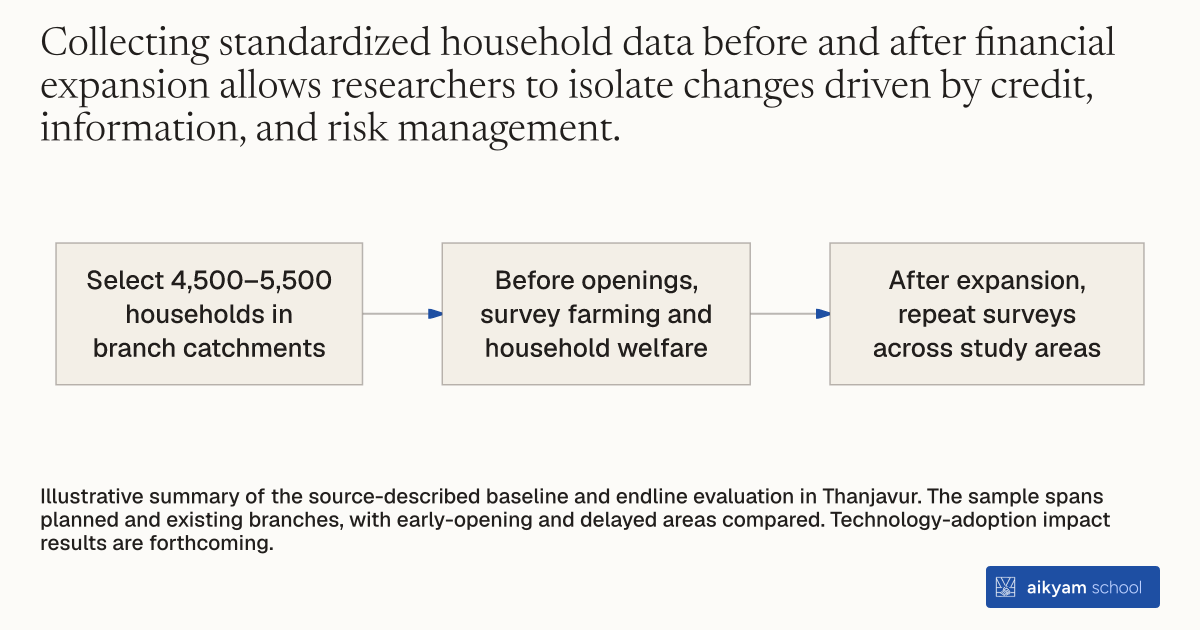
Survey households before and after expansion
- Select 4,500–5,500 households in branch catchments
- Before openings, survey farming and household welfare
- After expansion, repeat surveys across study areas
Illustrative summary of the source-described baseline and endline evaluation in Thanjavur. The sample spans planned and existing branches, with early-opening and delayed areas compared. Technology-adoption impact results are forthcoming.
See source →How
When to use
Measuring how rural financial service expansion affects household welfare and technology adoption requires systematic data collection before and after program delivery. Informal memory and non-standardized feedback fail to capture changes in farming habits, social interactions, or consumption. Conducting baseline and endline household surveys across treatment and control areas provides rigorous data to evaluate program impacts.
Administer baseline and endline household surveys across rural catchment areas to evaluate program effects on technology adoption and living standards.
- Field researchers select 4,500 to 5,500 households across planned and existing branch catchment areas in Thanjavur, Tamil Nadu.
- Surveyors conduct baseline household interviews before new rural financial service branches open.
- Field teams collect detailed data on agricultural activity, social interactions, household consumption, assets, and demographics.
- Surveyors return after branch expansion to conduct endline surveys measuring changes in financial use, technology adoption, and welfare.
Why it works
Comparing responses across treatment and control branches prevents outside economic trends from distorting impact measurements.
Example
Researchers with the Centre for Micro Finance surveyed between 4,500 and 5,500 households in Thanjavur, Tamil Nadu to evaluate how financial expansion altered credit access from a 2003 baseline of 27 percent.
About the study
Participants
4,500 to 5,500 households served by 100 to 120 planned rural financial service branches in Thanjavur, Tamil Nadu, India.
Study Design
Phased randomized controlled trial comparing 50 to 60 early branch areas against paired delayed expansion control areas evaluated via baseline and endline surveys.
Results
Per capita income in Tamil Nadu was US\$1,271 in 2008 with formal credit access at 27 percent in 2003, while empirical impact metrics on technology adoption are listed as forthcoming.