Research records
Compare surveys with health service records
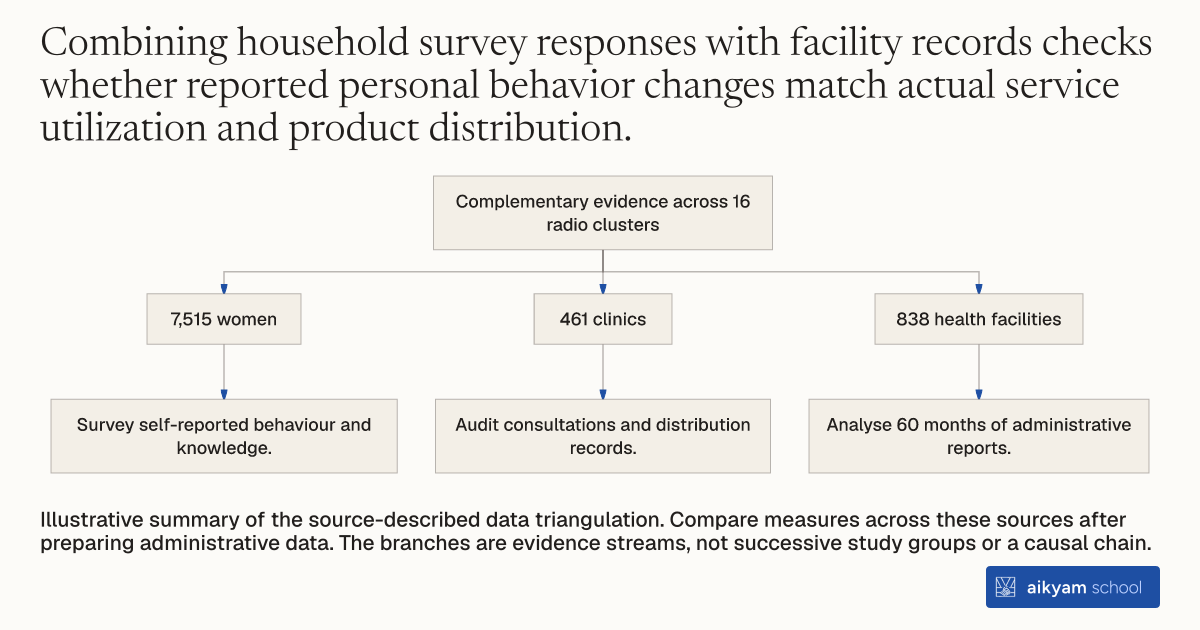
Complementary evidence across 16 radio clusters
- 7,515 women
- Survey self-reported behaviour and knowledge.
- 461 clinics
- Audit consultations and distribution records.
- 838 health facilities
- Analyse 60 months of administrative reports.
Illustrative summary of the source-described data triangulation. Compare measures across these sources after preparing administrative data. The branches are evidence streams, not successive study groups or a causal chain.
See source →How
When to use
In health program evaluations, relying solely on self-reported survey responses risks social desirability bias and recall errors. Evaluators need to verify self-reported behavioral changes against objective institutional records across target populations. Combining individual household surveys with local health facility surveys and nationwide administrative health registers provides multi-source empirical validation.
Triangulate evaluation data across individual surveys, facility-level audits, and monthly administrative reports to validate program impacts.
- Survey sampled primary target individuals across treatment and control areas to record self-reported behavior and knowledge changes.
- Audit operational health facilities serving target communities to collect facility-level consultation records and monthly distribution counts.
- Obtain official monthly administrative reporting data from national Ministry of Health registers for all health centers in study broadcast zones.
- Top-code administrative data at extreme percentiles and apply log or inverse hyperbolic sine transformations to smooth reporting skewness.
- Cross-examine self-reported individual behavioral shifts against facility consultation trends and administrative product distribution metrics.
Why it works
Cross-validating across distinct administrative and primary data streams mitigates individual reporting bias and accounts for missing facility records.
Example
In Burkina Faso, evaluators verified self-reported contraceptive uptake among 7,515 women by analyzing survey data from 461 local clinics and 60 months of administrative reports from 838 Ministry of Health facilities across 16 radio station clusters. The 5.9 percentage point increase in self-reported modern contraceptive use aligned with a 32 percent increase in clinic family planning consultations and an 11 percent increase in administrative injectable distribution.
About the study
Participants
7,515 women, 461 audited clinics, and 838 Ministry of Health facilities across 16 radio station broadcast zones in Burkina Faso.
Study Design
Multi-source data triangulation combining two-wave household panel surveys, clinic audits, and 60-month administrative panel fixed-effects analysis.
Results
Self-reported contraceptive use increased by 5.9 percentage points, clinic family planning consultations rose by 32 percent (from 31 to 45 monthly consultations), and administrative injectable distributions increased by 11 percent (2.6 additional units monthly).