Research steps
Measure reciprocity before reporting treatments
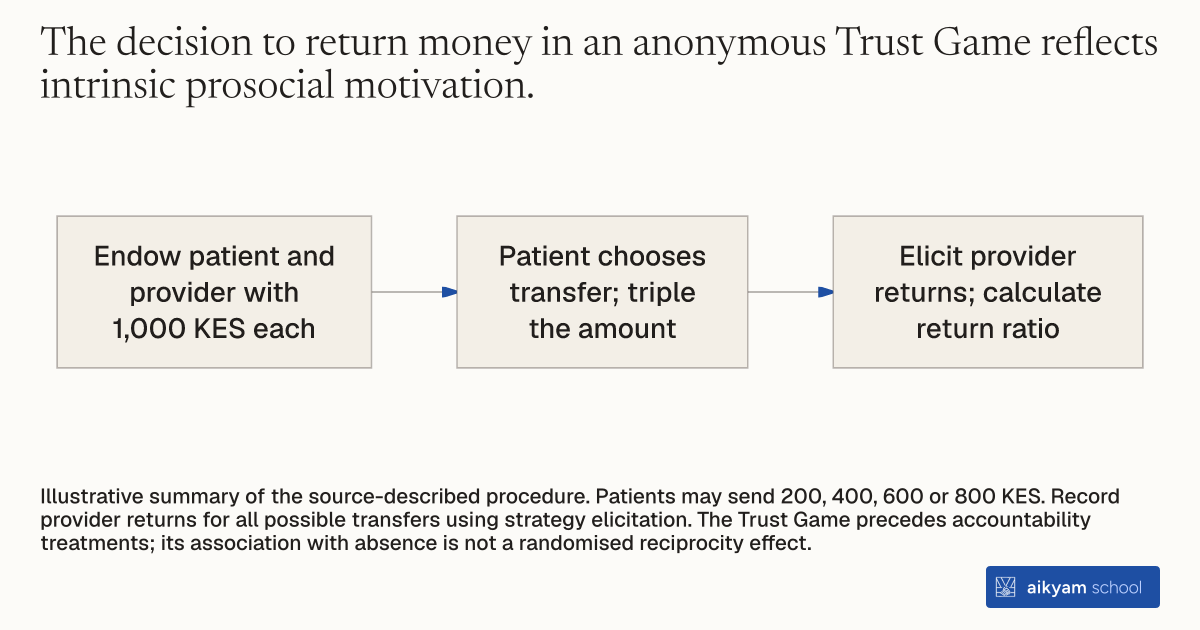
- Endow patient and provider with 1,000 KES each
- Patient chooses transfer; triple the amount
- Elicit provider returns; calculate return ratio
Illustrative summary of the source-described procedure. Patients may send 200, 400, 600 or 800 KES. Record provider returns for all possible transfers using strategy elicitation. The Trust Game precedes accountability treatments; its association with absence is not a randomised reciprocity effect.
See source →How
When to use
Frontline health facilities in developing countries face high worker absenteeism and low service effort that standard surveys fail to capture. Evaluators need an objective behavioral measure to assess frontline health worker prosocial motivation and reciprocity before introducing incentives. This baseline measurement tool quantifies provider intrinsic reciprocity through incentivized financial choices.
Measure frontline health provider baseline prosociality by running a standard two-player Trust Game before introducing accountability treatments.
- Give each patient participant an initial endowment of 1,000 KES and each health provider an endowment of 1,000 KES.
- Allow patients to send funds in multiples of 200 KES up to 800 KES to matched health providers.
- Triple any money sent by patients before delivering the transfer to matched providers.
- Use the strategy elicitation method to record the exact amount returned by providers across all possible incoming transfer amounts.
- Calculate the provider's returned-received ratio as the primary measure of baseline reciprocity.
Why it works
Providers who demonstrate higher reciprocity in the game possess stronger public service orientation and exhibit lower absenteeism in real life.
Example
In Nairobi, Kenya, researchers measured baseline reciprocity across 103 health providers and 216 patients from 93 health facilities before playing the Reporting Game. Public sector health providers returned an average ratio of 1.44 of received funds to patients compared to 1.00 for private sector providers.
About the study
Participants
103 health providers (77 public sector, 26 private sector) and 216 patients recruited from 93 health facilities in Nairobi, Kenya.
Study Design
Strategy-elicited standard Trust Game executed prior to reporting treatments, measuring provider return ratios across discrete patient transfer scenarios (200, 400, 600, 800 KES).
Results
Public sector health workers exhibited significantly higher baseline reciprocity than private sector workers (1.44 returned-received ratio vs 1.00, p = 0.019), and high baseline reciprocity predicted lower worker absenteeism during unannounced follow-up visits (38% absence rate for high-reciprocity public workers vs 61% for low-reciprocity workers).