Try, learn and adjust
Use roleplay feedback to guide follow-up
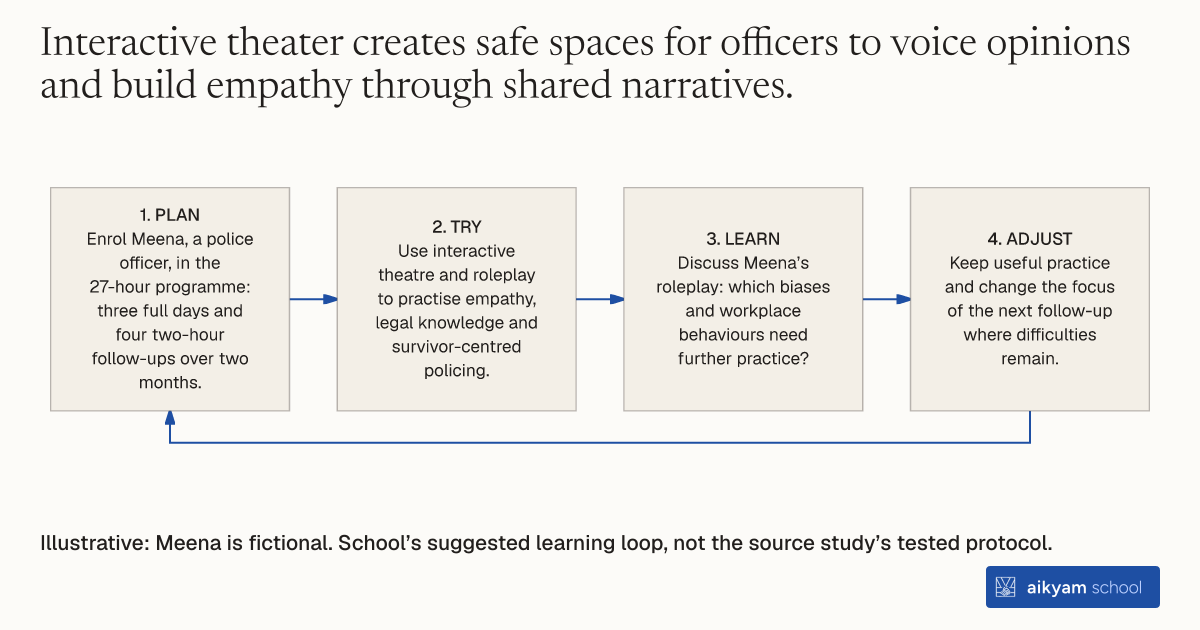
- Plan: Enrol Meena, a police officer, in the 27-hour programme: three full days and four two-hour follow-ups over two months.
- Try: Use interactive theatre and roleplay to practise empathy, legal knowledge and survivor-centred policing.
- Learn: Discuss Meena’s roleplay: which biases and workplace behaviours need further practice?
- Adjust: Keep useful practice and change the focus of the next follow-up where difficulties remain.
Illustrative: Meena is fictional. School’s suggested learning loop, not the source study’s tested protocol.
See source →School’s suggested, untested loop. Observe roleplay and follow-up discussions; effects on gender-based violence are not yet reported.
How
When to use
Police officers often hold victim-blaming attitudes and doubt reports of gender-based violence. This mindset prevents women from seeking help and lowers crime reporting. Apply this training to police personnel in high-violence regions to improve officer empathy.
Deliver a twenty-seven hour intensive gender-sensitization program using applied theater to train police officers.
- Facilitators host three full-day training sessions in groups of thirty officers.
- Trainers lead interactive theatre activities including Theatre of the Oppressed and Psychodrama to build safe discussion spaces.
- Facilitators guide discussions on civic service, officer biases, gender inequality, and survivor-centered policing skills.
- Officers practice empathy, technical legal knowledge, and workplace behaviors through roleplay enactments.
- Instructors conduct four two-hour follow-up sessions across two months to help officers apply concepts in daily station work.
Why it works
Immersive roleplay lets personnel practice soft skills and form supportive social norms around survivor-centered policing.
Example
Researchers partnered with the Bihar Police and NGO Mittika in Bihar, India to train 3,526 police officers across 217 randomly selected police stations using 27 hours of applied theater instruction.
About the study
Participants
3,526 police officers in 419 police stations across Bihar, India.
Study Design
Randomized controlled trial assigning 217 police stations to receive training and 202 police stations to a control group.
Results
Research ongoing; results forthcoming.