Try, learn and adjust
Check training fits police duties
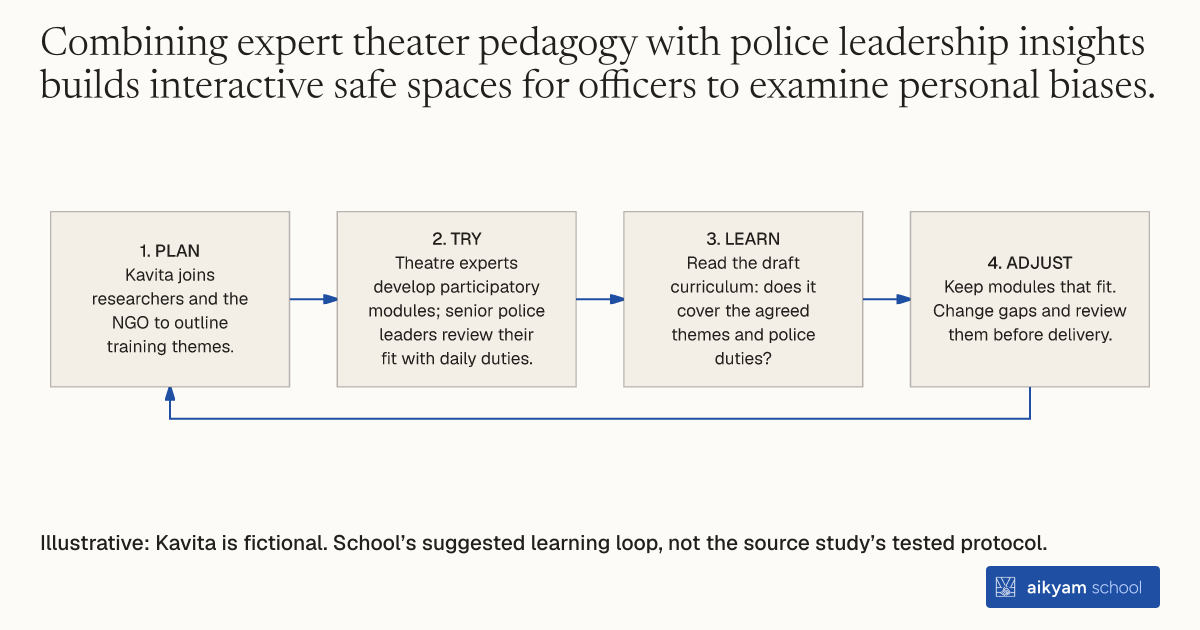
- Plan: Kavita joins researchers and the NGO to outline training themes.
- Try: Theatre experts develop participatory modules; senior police leaders review their fit with daily duties.
- Learn: Read the draft curriculum: does it cover the agreed themes and police duties?
- Adjust: Keep modules that fit. Change gaps and review them before delivery.
Illustrative: Kavita is fictional. School’s suggested learning loop, not the source study’s tested protocol.
See source →School’s suggested learning loop: observe curriculum coverage and police review; this is not a tested training effect.
How
When to use
When designing gender-sensitivity training for law enforcement, standard programs often fail to change deep-seated officer attitudes. Partnering academic researchers with specialized NGOs, theater professionals, and senior police leaders creates a balanced curriculum. Use this co-design approach when building institutional interventions for police personnel.
Co-design a gender-sensitive police training curriculum through multi-stakeholder collaboration among researchers, NGOs, theater experts, and senior police officials.
- Academic researchers form a design team with a specialized NGO to outline training objectives and core themes.
- Award-winning theater professionals integrate participatory methodologies like Theatre of the Oppressed and Psychodrama into workshop modules.
- Senior police leaders review draft materials to ensure alignment with legal duties and daily police station realities.
- Developers organize content into three full-day sessions and four two-hour follow-up practice modules covering seven core topics.
Why it works
Institutional co-ownership ensures the curriculum addresses real operational challenges while fostering survivor-centered policing.
Example
Researchers collaborated with the Delhi-based NGO Mittika, theater pioneer Jaya Iyer, and senior Indian Police Service officials to design a 27-hour training curriculum for 3,526 police officers in Bihar, India.
About the study
Participants
3,526 police officers in 419 police stations across Bihar, India.
Study Design
Randomized controlled trial assigning 217 police stations to receive training and 202 police stations to a comparison group.
Results
Research ongoing; results forthcoming.