Research design
Share information about women’s help desks
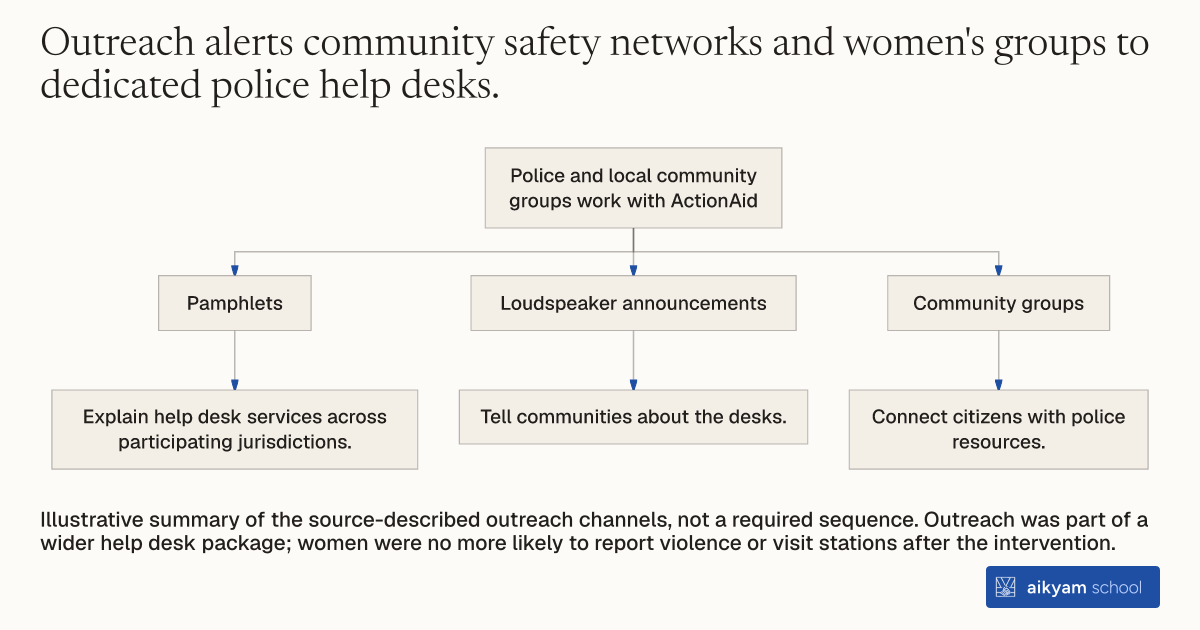
Police and local community groups work with ActionAid
- Pamphlets
- Explain help desk services across participating jurisdictions.
- Loudspeaker announcements
- Tell communities about the desks.
- Community groups
- Connect citizens with police resources.
Illustrative summary of the source-described outreach channels, not a required sequence. Outreach was part of a wider help desk package; women were no more likely to report violence or visit stations after the intervention.
See source →How
When to use
Women in many settings hesitate to report gender-based violence due to stigma and low trust in police. Civil society groups and local safety networks often lack awareness of newly established police help desks. Conducting targeted community outreach informs local networks and citizens about available police assistance for women.
Conduct community outreach in partnership with local groups to raise awareness of women's help desks.
- Police officers partner with local community groups and ActionAid to plan outreach activities.
- Police and community groups distribute pamphlets regarding help desks across participating station jurisdictions.
- Police officers broadcast loudspeaker announcements in local communities to announce help desk services.
- Officers and community leaders form community groups to connect citizens with police resources.
Why it works
Informing local organizations helps bridge gaps between citizens and law enforcement structures.
Example
The Madhya Pradesh Police Department and ActionAid conducted community outreach across 120 police station jurisdictions in India. Teams distributed pamphlets, made loudspeaker announcements, and created community groups to raise awareness of women's help desks.
About the study
Participants
180 police stations across 12 representative districts in Madhya Pradesh, India, serving average populations of 130,000 per station.
Study Design
A randomized evaluation comparing 120 police stations receiving help desks, training, and community outreach against 60 control stations.
Results
Women were no more likely to report experiences of gender-based violence or visit police stations following the outreach intervention. However, stations receiving the multi-component intervention registered 1.5 Domestic Incident Reports and 4.4 First Information Reports per month, compared to 0.05 DIRs and 3.8 FIRs in comparison stations.