Research overview
Randomise borrower groups
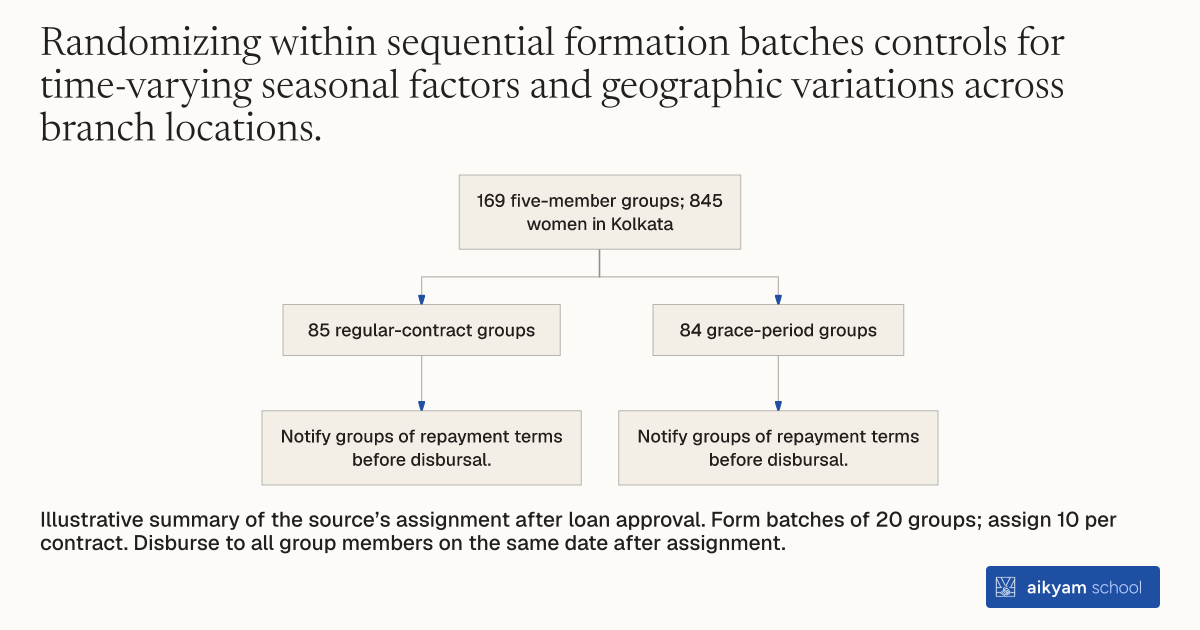
169 five-member groups; 845 women in Kolkata
- 85 regular-contract groups
- Notify groups of repayment terms before disbursal.
- 84 grace-period groups
- Notify groups of repayment terms before disbursal.
Illustrative summary of the source’s assignment after loan approval. Form batches of 20 groups; assign 10 per contract. Disburse to all group members on the same date after assignment.
See source →How
When to use
Researchers conducting field experiments with microfinance institutions need to assign debt contracts fairly without selection bias. Randomizing treatment across client cohorts as groups form prevents timing and location confounding while maintaining administrative workflow. Assigning debt terms within small sequential batches creates balanced experimental arms over an extended recruitment period.
Assign microfinance loan groups to experimental debt contracts in sequential batches as client groups complete pre-loan approval.
- Form five-member borrower groups and approve individual loans through standard branch procedures.
- Accumulate newly formed loan groups into sequential batches of twenty groups based on formation timing.
- Randomize ten loan groups within each batch to receive a grace period contract and ten groups to receive a regular contract.
- Notify loan officers and borrower groups of their assigned repayment schedule prior to loan disbursal.
- Disburse loan capital to all group members on the same date following treatment assignment.
Why it works
Assigning contracts after loan approval prevents selective client dropout prior to loan disbursal.
Example
Researchers randomized 169 five-member loan groups in Kolkata across sequential batches of twenty groups between March and December 2007. Eighty-five groups received regular repayment contracts and eighty-four groups received two-month grace period contracts, with zero client dropout occurring between randomization and loan disbursal.
About the study
Participants
845 low-income female microfinance clients in 169 five-member loan groups across Kolkata, India.
Study Design
Stratified randomized field experiment assigning treatment within sequential batches of 20 groups based on timing of group formation.
Results
Batch-based group randomization assigned 85 groups to regular contracts and 84 groups to grace period contracts with zero attrition between assignment and disbursal, establishing balanced baseline characteristics across 10 of 11 invariant variables.