Research design
Assign offers within the survey
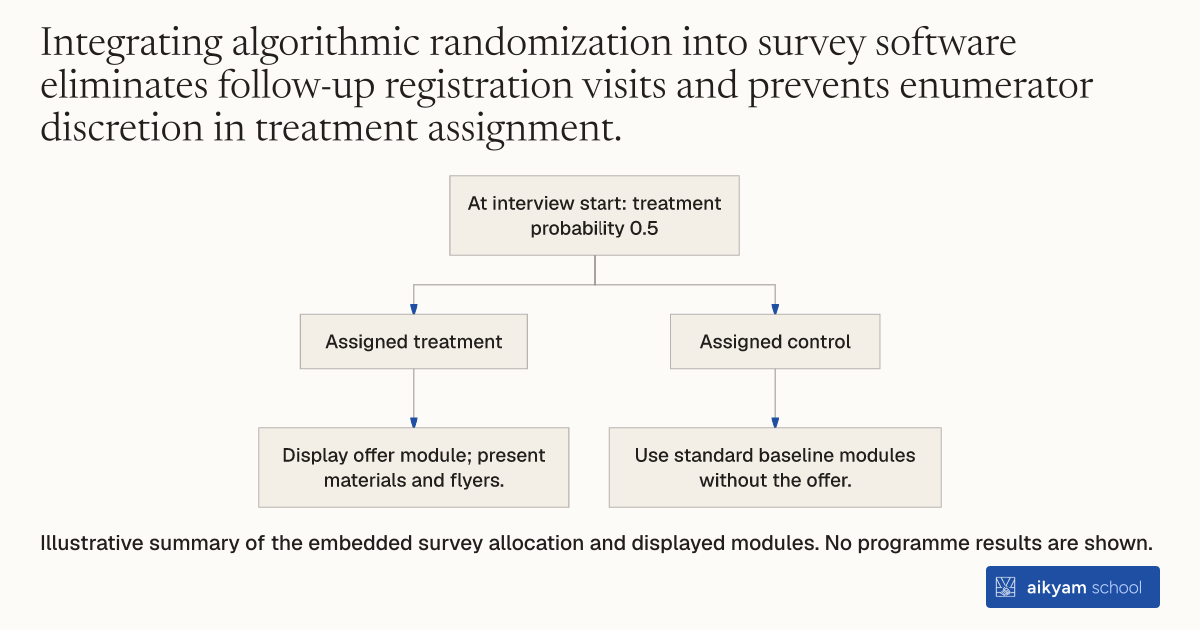
At interview start: treatment probability 0.5
- Assigned treatment
- Display offer module; present materials and flyers.
- Assigned control
- Use standard baseline modules without the offer.
Illustrative summary of the embedded survey allocation and displayed modules. No programme results are shown.
See source →How
When to use
In field experiments requiring rapid enrollment, conducting baseline surveys and returning later for treatment assignment introduces delays and administrative overhead. Researchers need a streamlined protocol to assign treatment immediately during household interviews without sacrificing randomized allocation. By embedding algorithmic treatment assignment directly into electronic survey software, field teams deliver intervention offers instantly during initial visits.
Embed real-time algorithmic randomization directly into tablet survey software to execute immediate treatment assignment during household interviews.
- Program the digital survey application to trigger treatment assignment automatically at the start of each interview as noted in SI Section G.
- Set the algorithm to assign treatment with an unconditional 0.5 probability for each screened household.
- Program the software interface to dynamically display the land titling offer module only when a household is selected for treatment.
- Instruct enumerators to present program materials and informational flyers immediately to respondents assigned to the treatment condition.
- Administer standard baseline survey modules to control households without displaying the titling offer.
Why it works
This accelerates participant enrollment while maintaining a consistent 50 percent assignment probability.
Example
Survey teams in Kananga, DRC, used embedded real-time survey randomization across 364 neighborhoods, assigning eligible respondents to treatment with a 0.5 probability during baseline interviews to accelerate enrollment.
About the study
Participants
4,343 randomly sampled households across 364 neighborhoods in Kananga, Democratic Republic of Congo, with 483 eligible households in the main analysis sample.
Study Design
Randomized controlled trial comparing offline polygon-stratified randomization with an embedded real-time survey software randomization algorithm with 0.5 treatment probability.
Results
Program assignment caused a 44 percentage point increase in initiation of the land titling process and a 13.7 percentage point increase in actual receipt of formal land titles.