Research design
Assign assistance by day of birth
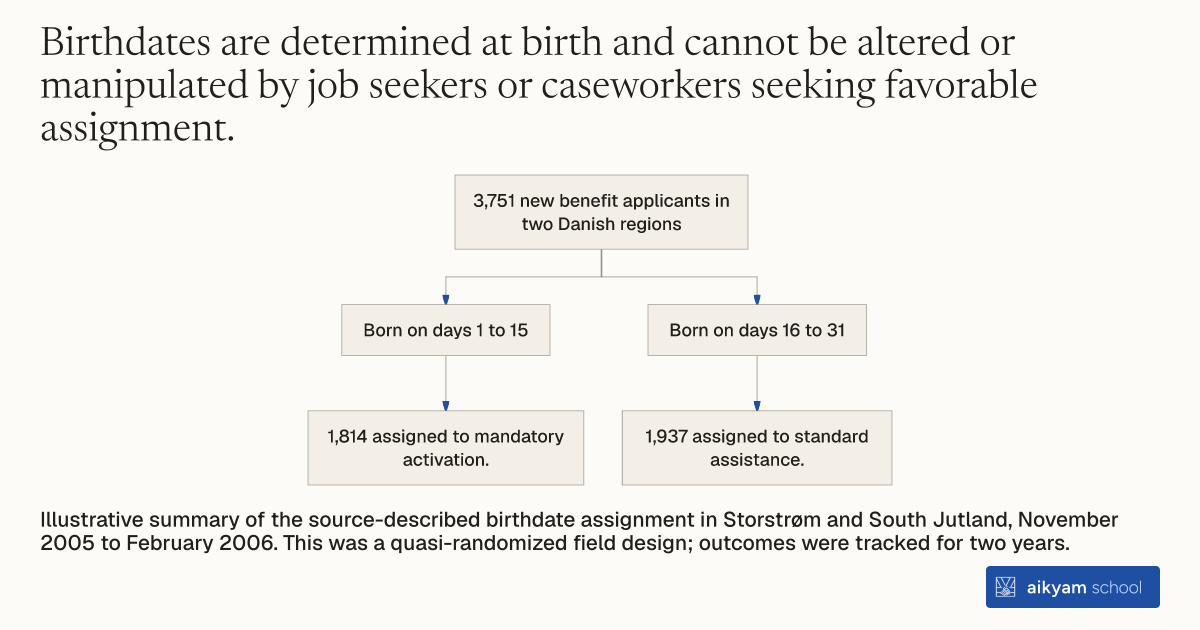
3,751 new benefit applicants in two Danish regions
- Born on days 1 to 15
- 1,814 assigned to mandatory activation.
- Born on days 16 to 31
- 1,937 assigned to standard assistance.
Illustrative summary of the source-described birthdate assignment in Storstrøm and South Jutland, November 2005 to February 2006. This was a quasi-randomized field design; outcomes were tracked for two years.
See source →How
When to use
Program evaluators need to test a new active labor market intervention among newly registered benefit recipients without subject self-selection bias. Standard individual-level randomization can be difficult to implement administratively in field offices. Assigning participants based on day of birth provides a transparent, unmanipulable field trial design.
Randomize newly registered unemployment benefit applicants into treatment and control groups based on their day of birth within the month.
- Identify all job seekers applying for regular unemployment insurance benefits across target experimental regions during a specified intake window.
- Check each newly registered applicant's official date of birth in administrative records.
- Assign applicants born on the 1st through the 15th day of any calendar month to the active treatment group.
- Assign applicants born on the 16th through the 31st day of any calendar month to the control group.
- Provide the mandatory activation program to the treatment group while maintaining standard assistance for the control group.
Why it works
This ensures strict ex-ante orthogonal assignment to treatment and control conditions across observed and unobserved individual characteristics.
Example
Public employment offices in Storstrøm and South Jutland randomized 3,751 newly unemployed workers applying for benefits between November 2005 and February 2006 by birthdate, assigning 1,814 workers born on days 1–15 to activation and 1,937 workers born on days 16–31 to standard assistance.
About the study
Participants
3,751 newly unemployed workers (1,814 treatment, 1,937 control) across Storstrøm and South Jutland, Denmark.
Study Design
Quasi-randomized field experiment assigning individuals based on birthdate day of the month (1–15 vs 16–31) tracked over two years using national administrative registries.
Results
Treatment group participants exited unemployment significantly faster, reaching 50% re-employment in 11 weeks compared to 13 weeks for the control group, with a 20% higher exit hazard rate.