Research groups
Randomise utility consumer groups
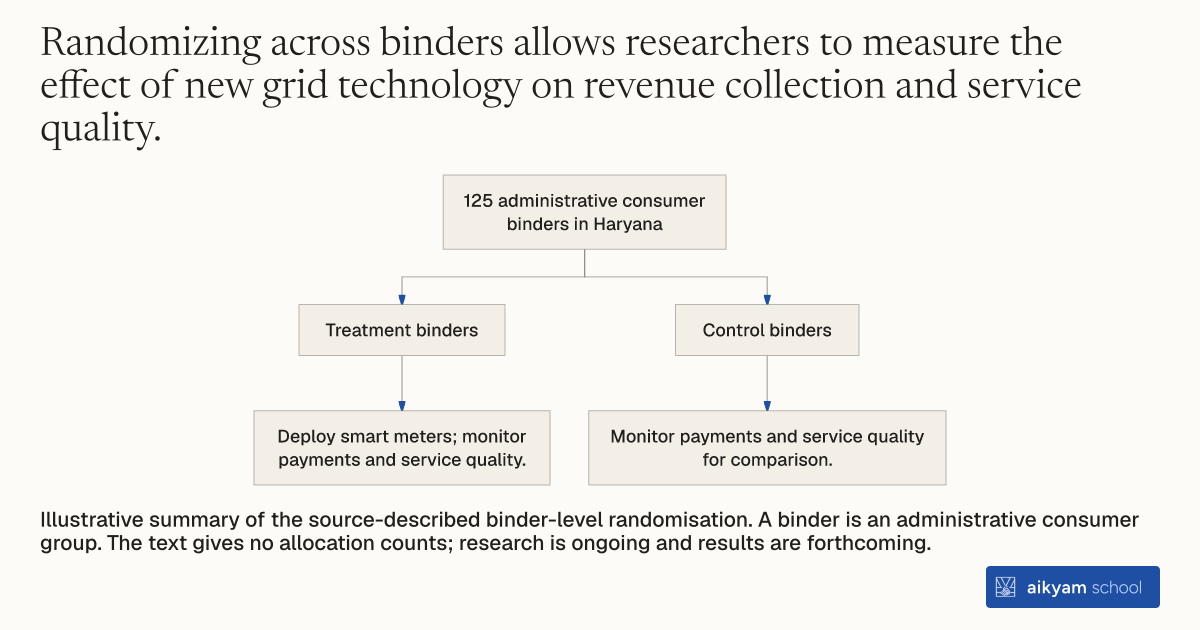
125 administrative consumer binders in Haryana
- Treatment binders
- Deploy smart meters; monitor payments and service quality.
- Control binders
- Monitor payments and service quality for comparison.
Illustrative summary of the source-described binder-level randomisation. A binder is an administrative consumer group. The text gives no allocation counts; research is ongoing and results are forthcoming.
See source →How
When to use
State-run electricity distribution companies struggle with widespread theft and unpaid bills. Evaluators need to test if technological interventions like smart meters improve consumer payments and service quality. This method helps researchers and utility providers measure the impact of grid infrastructure upgrades on revenue and service reliability.
Randomize consumer binders into treatment and control groups to evaluate electricity interventions.
- Group target electricity consumers into distinct administrative binders.
- Select 125 consumer binders for the study sample in Haryana, India.
- Assign binders randomly to receive the new technology intervention or serve as comparison units.
- Deploy smart meters in treatment binders while monitoring control binders.
- Record consumer payments and service quality across binders over time.
Why it works
Comparing metered binders to control binders separates technology impacts from other utility trends.
Example
J-PAL South Asia, EEG, and UK International Development conducted a randomized evaluation across 125 binders in Haryana, India, under AEA RCT registration number AEARCTR-0006022.
About the study
Participants
125 binders of electricity consumers in Haryana, India.
Study Design
Randomized evaluation conducted by J-PAL South Asia in partnership with EEG and UK International Development (AEA RCT registration number AEARCTR-0006022).
Results
Research is ongoing and results are forthcoming to test the impact of smart meters on consumer payments and service quality.