Research procedure
Measure teacher attendance from fingerprints
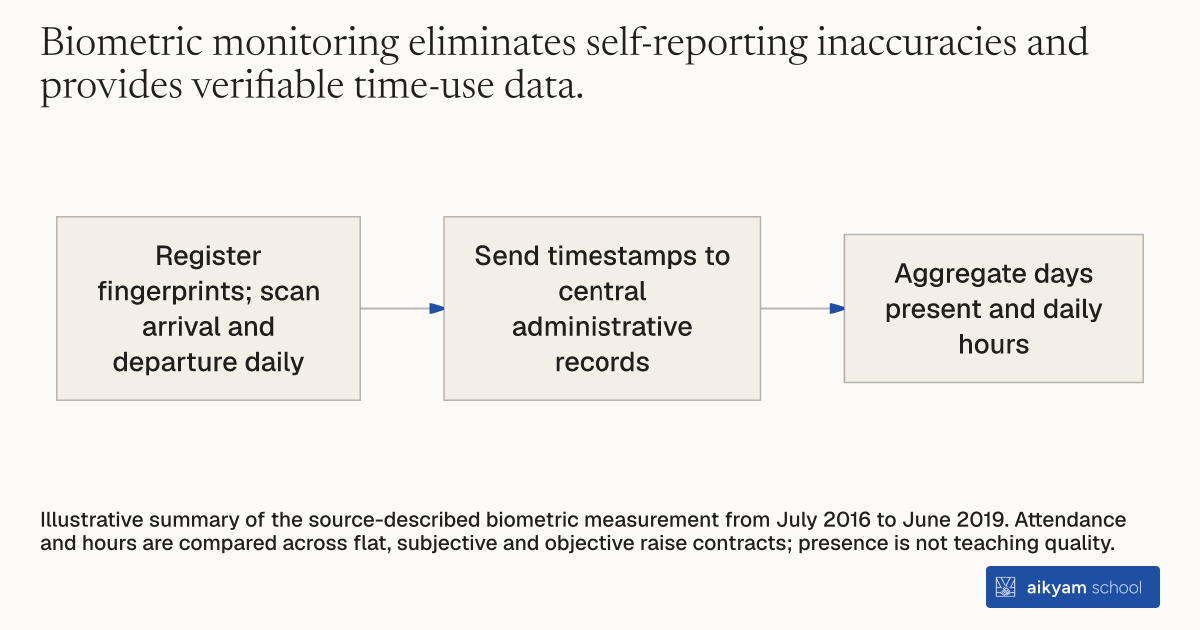
- Register fingerprints; scan arrival and departure daily
- Send timestamps to central administrative records
- Aggregate days present and daily hours
Illustrative summary of the source-described biometric measurement from July 2016 to June 2019. Attendance and hours are compared across flat, subjective and objective raise contracts; presence is not teaching quality.
See source →How
When to use
School systems face high rates of teacher absenteeism and uncertain workplace presence data. Paper sign-in logs allow buddy punching and retrospective falsification, preventing managers from accurately measuring physical attendance. Biometric clock-in terminals provide tamper-resistant daily attendance records for school networks.
Monitor employee presence by capturing daily arrival and departure times using biometric fingerprint terminals linked to central human resources databases.
- Install electronic biometric fingerprint clock-in and clock-out terminals at school entrances across all network campuses.
- Register baseline fingerprint templates for all core subject teachers into the school system's administrative database at the start of employment.
- Require teachers to scan their fingerprints upon arrival and departure every working day throughout the July-to-June academic cycle.
- Transmit daily clock-in and clock-out timestamp records directly from local school terminals to central administrative servers.
- Aggregate individual employee attendance files to compute annual days present and average daily working hours.
- Share administrative attendance metrics with school managers to evaluate baseline employee effort and subjective raise eligibility.
Why it works
When paired with subjective raise contracts, employees respond to observed attendance metrics because managers directly reward physical presence at work.
Example
A private school network in Pakistan tracked daily biometric clock-in and clock-out data for core teachers across 295 school clusters over three years. Under subjective raises, teachers increased their workplace presence by 5.927 days per year relative to the 144.79-day control baseline, while working an average of 7.90 hours per day.
About the study
Participants
6,394 teacher-level administrative attendance records across 295 school clusters in private schools in Pakistan.
Study Design
Randomized controlled trial (RCT) using daily biometric clock-in and clock-out administrative data collected from July 2016 through June 2019 to evaluate teacher days present and hours worked under flat, subjective, and objective raise contracts.
Results
Subjective incentives significantly increased teacher attendance by 5.927 days present per year relative to control (p = 0.0719; 3.340 days present in restricted sample, p = 0.00947), whereas objective incentives generated a non-statistically significant increase of 2.426 days (p = 0.570), with no significant change in daily hours worked across arms (control mean = 7.90 hours per day).