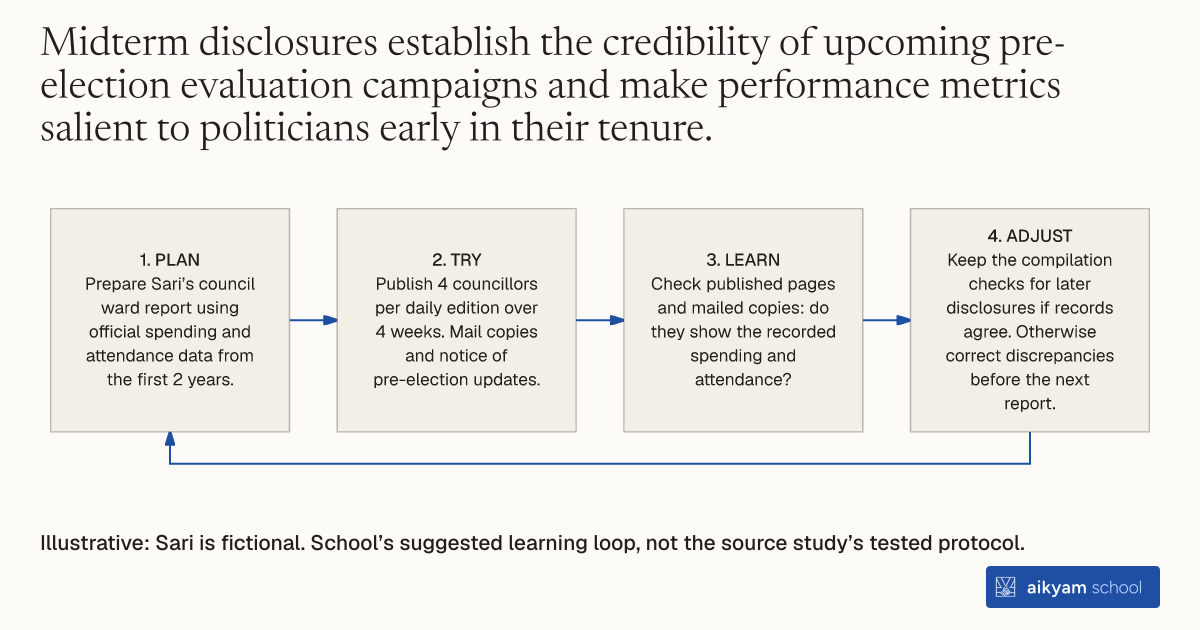
Try, learn and adjust
Check midterm performance disclosures reach officials
- Plan: Prepare Sari’s council ward report using official spending and attendance data from the first 2 years.
- Try: Publish 4 councillors per daily edition over 4 weeks. Mail copies and notice of pre-election updates.
- Learn: Check published pages and mailed copies: do they show the recorded spending and attendance?
- Adjust: Keep the compilation checks for later disclosures if records agree. Otherwise correct discrepancies before the next report.
Illustrative: Sari is fictional. School’s suggested learning loop, not the source study’s tested protocol.
See source →School’s suggested learning loop: observe report accuracy and notification. Midterm and pre-election effects were statistically indistinguishable from promising pre-election reports alone.
How
When to use
Voters and politicians in local electoral wards often lack verifiable, mid-term data on municipal performance during an active legislative term. This information asymmetry allows elected councilors to misalign spending away from constituent needs without early public feedback. Publishing midterm performance report cards in high-circulation newspapers establishes credibility for future disclosures and makes governance performance salient midway through a term.
Publish midterm report cards in a widely read daily newspaper to establish credibility and highlight official performance metrics two years into a municipal term.
- Obtain official councilor performance data on discretionary spending, committee membership, and assembly attendance covering the first two years of a term via Right-to-Information Act requests.
- Compile individual midterm report cards displaying councilor photographs, committee attendance rates, general assembly attendance, and spending allocations across infrastructure categories.
- Publish the midterm report cards daily over four weeks in a major newspaper, featuring groups of four councilors per edition.
- Mail official notification letters accompanied by printed newspaper copies of the published midterm report cards directly to selected councilors.
- Notify councilors in writing that updated report cards on their full performance record will be published immediately prior to the next election.
Why it works
Publicizing administrative records midway through a term gives councilors clear feedback and time to adjust discretionary resource allocations before the final election.
Example
In Delhi, India, an NGO partner and the daily newspaper Dainik Hindustan published midterm report cards for 110 randomly selected municipal councilors in May and June 2010. The report cards covered administrative performance data spanning April 2007 to March 2009 across 110 municipal wards. Councilors who received midterm report cards maintained high performance levels similar to those only promised end-of-term report cards, demonstrating that midterm disclosures credibly anchored expectations of pre-election accountability.
About the study
Participants
110 municipal wards randomly selected out of 240 study wards in Delhi, India, covering urban voters and slum communities.
Study Design
A randomized controlled trial comparing 110 wards assigned to receive both midterm (2010) and pre-election (2012) report cards against 58 wards assigned to receive only pre-election report cards and 72 control wards.
Results
Midterm report cards were published for 110 councilors over one month starting May 27, 2010, covering performance from April 2007 to March 2009. The combination of midterm and pre-election report cards produced spending and attendance effects that were statistically indistinguishable from promising pre-election disclosures alone.