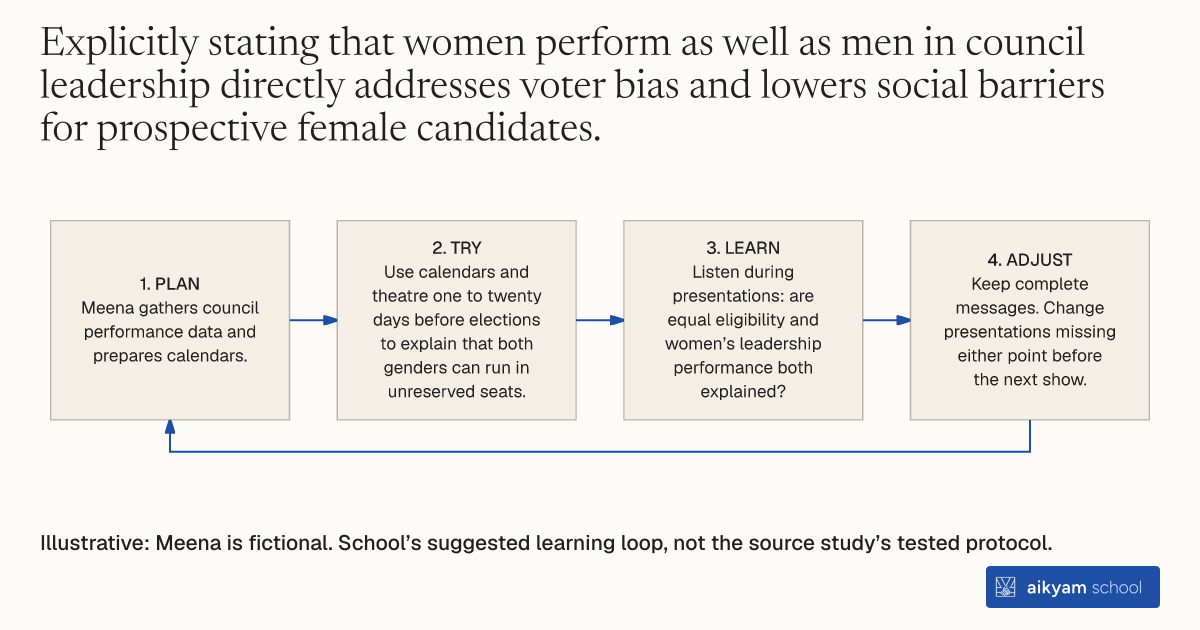
Try, learn and adjust
Check gender messages accompany performance information
- Plan: Meena gathers council performance data and prepares calendars.
- Try: Use calendars and theatre one to twenty days before elections to explain that both genders can run in unreserved seats.
- Learn: Listen during presentations: are equal eligibility and women’s leadership performance both explained?
- Adjust: Keep complete messages. Change presentations missing either point before the next show.
Illustrative: Meena is fictional. School’s suggested learning loop, not the source study’s tested protocol.
See source →Observe performance information and gender messages; the campaign says women leaders typically perform as well as men. School suggests this learning loop; it is not the source’s tested procedure.
How
When to use
In rural local governance, female candidates face social barriers and bias regarding their leadership abilities, leading to low political participation in unreserved elections. This method uses gender-focused voter awareness during local election campaigns to encourage female candidate entry and reassure voters about women's performance as council leaders. It is intended for election districts and non-governmental organizations working to promote gender equity in democratic elections.
Deliver a gender-focused voter information campaign alongside general performance metrics before council elections.
- NGO staff collect government data on council leaders' past job performance in implementing social programs like MGNREGA.
- Campaign staff design calendar posters containing leader performance data and roles.
- Teams highlight in campaign materials that both men and women can run for office in unreserved council seats.
- Presenters inform citizens during local theater shows that female council heads typically perform as well as male leaders.
- Workers perform street theater shows and distribute calendar posters across target villages between 1 and 20 days prior to election day.
Why it works
Providing performance data alongside gender equality messages encourages accountability and broader political participation.
Example
NGO Prayatn Sanstha carried out the gender information campaign across election districts in Rajasthan, India prior to the 2010 village council elections. The campaign reached target villages through 472 theatrical performances and 130,000 calendar posters, reaching an average of 32 percent of the adult population. Exposure to the information campaign led to an average increase of one additional candidate entering each election in councils where seats were not previously reserved for women.
About the study
Participants
382 village councils representing rural populations in Rajasthan, India.
Study Design
Randomized controlled trial assigning election districts randomly to receive either a general voter information campaign, a gender-focused information campaign, or no campaign.
Results
Exposure to the information campaign increased candidate entry by one additional candidate in non-reserved village councils where the baseline average was seven candidates. The information campaign particularly increased candidate participation among lower castes and tribal candidates. Incumbents performing one standard deviation below mean performance were 22 percent less likely to run for reelection in villages exposed to the campaign.