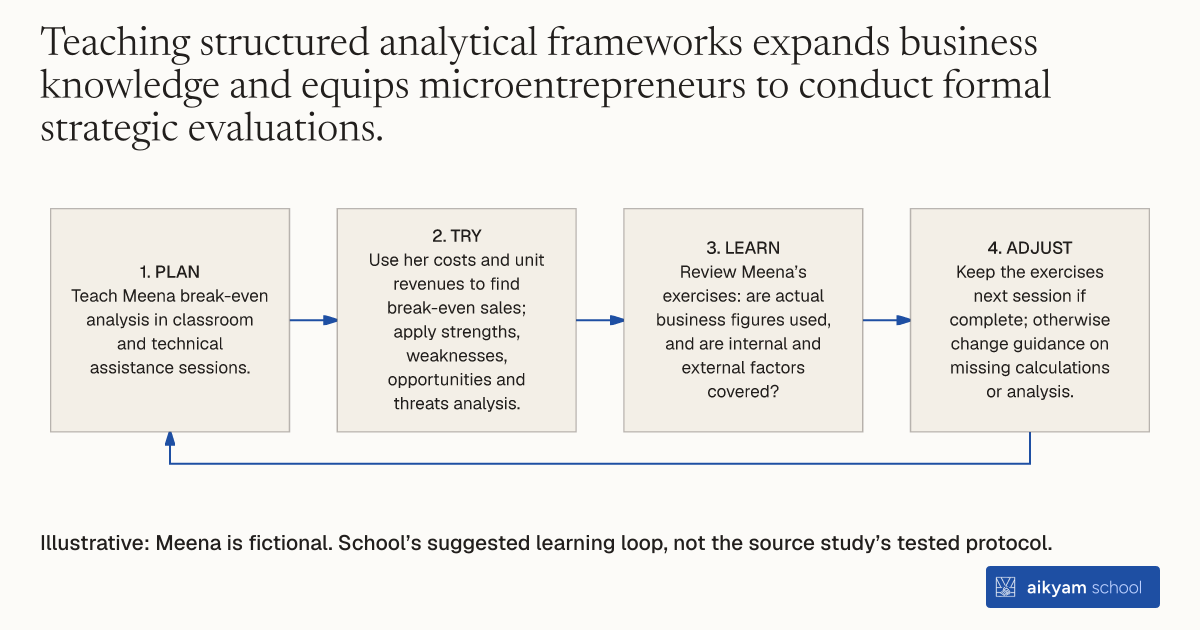
Try, learn and adjust
Check business analysis uses the owner’s figures
- Plan: Teach Meena break-even analysis in classroom and technical assistance sessions.
- Try: Use her costs and unit revenues to find break-even sales; apply strengths, weaknesses, opportunities and threats analysis.
- Learn: Review Meena’s exercises: are actual business figures used, and are internal and external factors covered?
- Adjust: Keep the exercises next session if complete; otherwise change guidance on missing calculations or analysis.
Illustrative: Meena is fictional. School’s suggested learning loop, not the source study’s tested protocol.
See source →School’s suggested, untested learning loop. Observe completed business analyses; do not attribute household income effects to these exercises alone.
How
When to use
Informal microentrepreneurs often lack structured methods to evaluate firm profitability and strategic positioning. Standardizing core analytical tools helps small business owners systematically assess costs, revenues, market opportunities, and operational risks. This approach serves informal microentrepreneurs participating in basic business skills courses.
Teach microentrepreneurs how to apply break-even point analysis and SWOT analysis tools during business training sessions.
- Introduce break-even point analysis formulas during classroom and technical assistance sessions.
- Guide microentrepreneurs to calculate fixed costs, variable costs, and unit revenues using their actual business figures.
- Determine the minimum sales volume required for each participant's enterprise to cover all operating expenses without incurring losses.
- Introduce the SWOT framework to analyze internal business strengths and weaknesses alongside external opportunities and threats.
- Direct participants to complete structured business analysis exercises applying both frameworks to their own microenterprises.
Why it works
Combining business tools with individual or group technical guidance translates theoretical concepts into practical operational habits.
Example
In Chile, Simón de Cirene taught break-even point analysis and SWOT analysis across basic skills courses reaching 1,347 low-income microentrepreneurs, 92 percent of whom were women. Participants receiving individualized technical assistance alongside these analytical exercises achieved an average monthly household income of US\$259 to US\$265 one year later, compared to US\$228 in the comparison group.
About the study
Participants
1,347 microentrepreneurs across 53 basic skills courses in Chile, 92 percent female, with all belonging to the lowest two income quartiles.
Study Design
Within 53 courses teaching basic skills, researchers randomly assigned participants to receive individualized technical assistance at their business, individualized technical assistance before or after class, or group assistance, evaluating learning through in-class tests and phone surveys one year post-program.
Results
Individualized assistance covering these business strategies increased average monthly household income to US\$259–US\$265 compared to US\$228 in the comparison group, while significantly increasing final exam scores and the number of business analyses conducted.