Try, learn and adjust
Check business concepts are understood
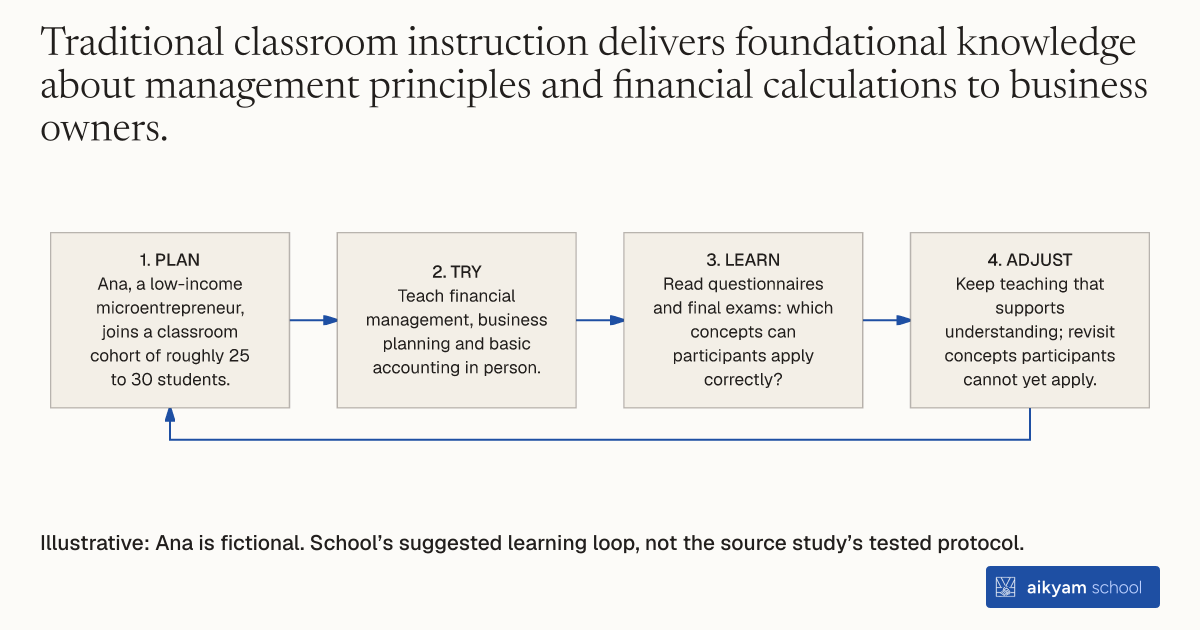
- Plan: Ana, a low-income microentrepreneur, joins a classroom cohort of roughly 25 to 30 students.
- Try: Teach financial management, business planning and basic accounting in person.
- Learn: Read questionnaires and final exams: which concepts can participants apply correctly?
- Adjust: Keep teaching that supports understanding; revisit concepts participants cannot yet apply.
Illustrative: Ana is fictional. School’s suggested learning loop, not the source study’s tested protocol.
See source →School’s suggested loop, not a tested source procedure. Observe learning assessments. Classroom learning alone does not establish business growth.
How
When to use
Informal microentrepreneurs in low-income populations often experience poor growth and low productivity. This approach provides structured instruction to overcome constraints in financial and managerial skills. It serves microentrepreneurs who operate small businesses or wish to open one.
Deliver standard in-person classroom business courses to groups of informal microentrepreneurs.
- Target microentrepreneurs in the lowest two income quartiles who own or wish to start a small enterprise.
- Group participants into classroom cohorts of roughly 25 to 30 students.
- Provide intensive in-person instruction covering financial management and general business operations.
- Teach participants foundational concepts, including business planning and basic accounting techniques.
- Evaluate participant learning through standard in-class questionnaires and final exams.
Why it works
However, standard classroom training alone often fails to generate business growth because participants struggle to translate concepts into practical daily routines.
Example
Simón de Cirene delivered conventional classroom training courses to informal microentrepreneurs across Chile between 2013 and 2015. Out of 1,712 participants in 66 courses, 92 percent were women, half had completed high school, and 30 percent had technical or university education. Participants in comparison groups receiving only standard classroom instruction earned an average of US\$228 per month.
About the study
Participants
1,712 participants across 66 training courses in Chile, where 92 percent were women and all belonged to the lowest two income quartiles.
Study Design
A randomized evaluation conducted by researchers from J-PAL and partner universities compared standard classroom courses against courses augmented with personalized components, tracking outcomes via administrative data and phone surveys one year after program start.
Results
Participants receiving conventional classroom training without personalized components earned an average household income of US\$228 per month, whereas adding personalized components increased household income by US\$30 to US\$50 (about 15 percent).