In Simple Words
Searching for work with basic advice is like sending out cold resumes into a dark void. Pairing dedicated employment liaisons who actively negotiate directly with local employers alongside hands-on digital skills instruction acts like a professional matchmaking service that places job seekers straight into suitable open positions.
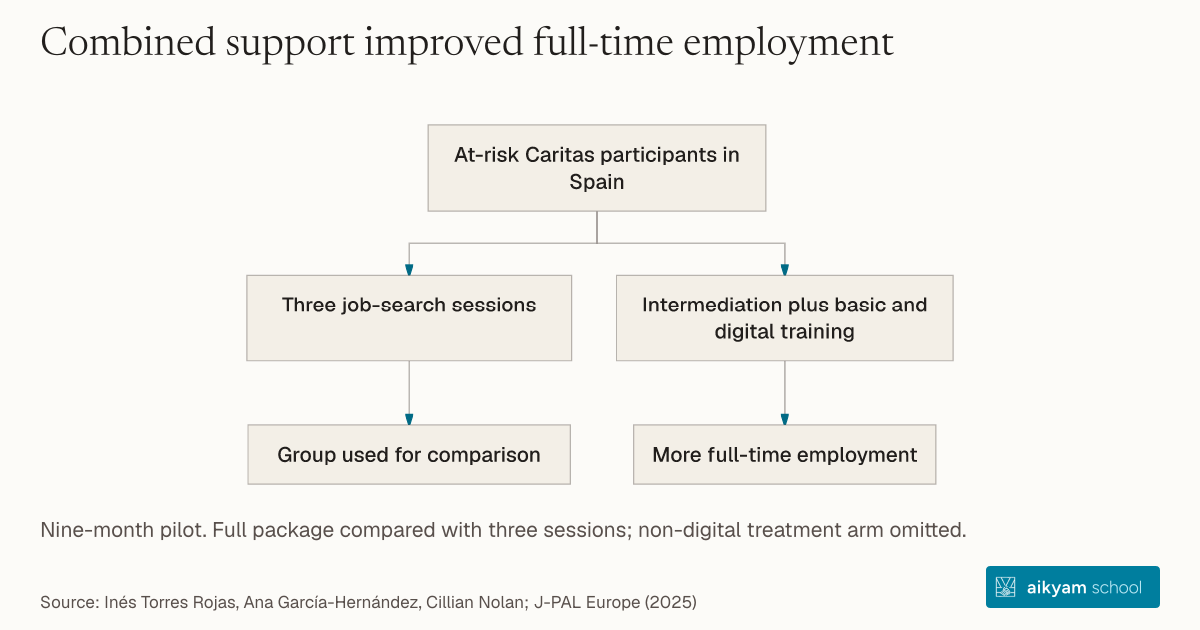
At-risk Caritas participants in Spain
- Three job-search sessions
- Group used for comparison
- Intermediation plus basic and digital training
- More full-time employment
Nine-month pilot. Full package compared with three sessions; non-digital treatment arm omitted.
See source →Research question
Standard job search workshops for vulnerable welfare recipients rarely lead to formal, high-quality employment unless accompanied by direct business intermediation and specialized digital competency instruction.
Participants
2,364 working-age individuals at risk of poverty across 11 Spanish provinces (656 Treatment 1, 653 Treatment 2, 1,055 comparison).
Study Design
Randomised Controlled Trial (RCT) by Cáritas evaluating Treatment 1 (4 job search sessions, 8 basic skills, direct employer intermediation) and Treatment 2 (Treatment 1 + 8 digital skills sessions) over 9 months against a comparison group receiving 3 job search sessions.
Results
Treatment 2 (combining employer intermediation with digital skills) significantly improved quality employment outcomes, increasing the probability of full-time employment, the number of full-time days worked, and overall employment intensity, while decreasing loan default rates.
Takeaway
Combine direct employer matching liaisons with eight mandatory digital skills training sessions to boost full-time employment rates among job seekers at risk of poverty.
Source and citation
See source →Read alongside the research
Plain-English glossary
Original explanations, informed by the references below. Examples are illustrations, not data from the studies above. The research text stays unchanged.
- Randomized controlled trial
A study that uses chance, like drawing lots, to decide who receives each option being compared. Researchers compare the groups’ outcomes to estimate the effect of those options.
ExampleA lottery assigns volunteers to a training programme or a comparison group. Researchers then compare their outcomes.
GET-IT glossary · Randomized study ↗Read more about randomized controlled trial →