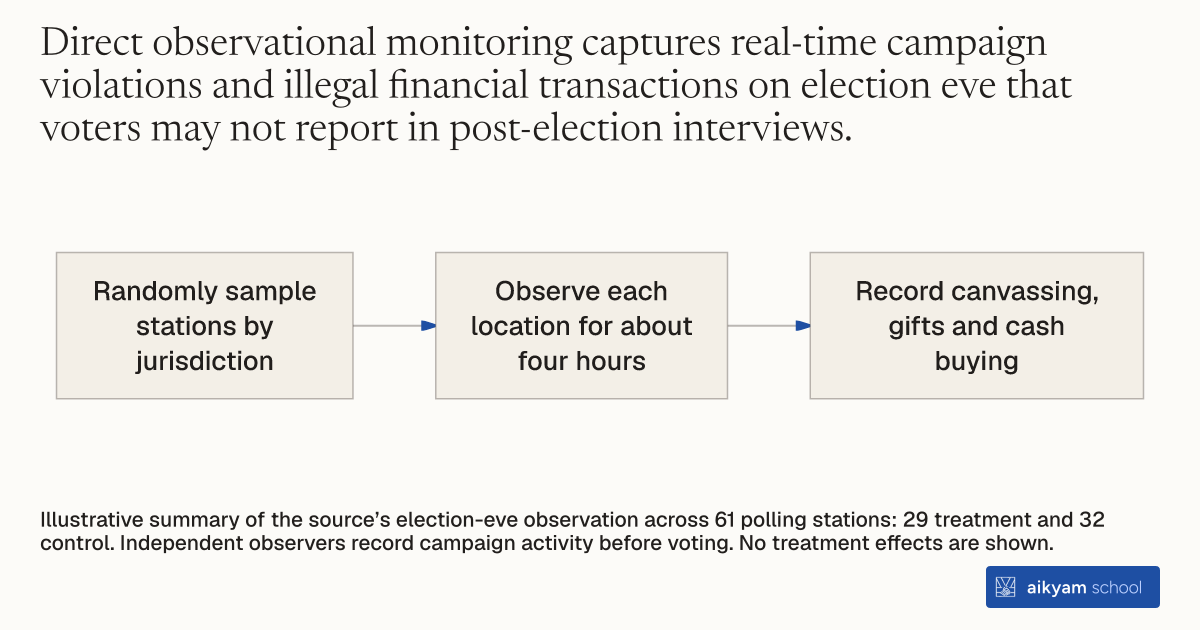
Research procedure
Observe campaigning on election eve
- Randomly sample stations by jurisdiction
- Observe each location for about four hours
- Record canvassing, gifts and cash buying
Illustrative summary of the source’s election-eve observation across 61 polling stations: 29 treatment and 32 control. Independent observers record campaign activity before voting. No treatment effects are shown.
See source →How
When to use
Political parties in low-income urban democracies often deploy illegal inducements such as cash bribes, food, liquor, and clothing on the eve of elections to influence voters. Standard post-election surveys frequently miss short-lived election-eve malpractices because transactions occur covertly in informal settlements. Independent observers stationed near polling locations track local campaign activities and quantify illegal gift-giving and cash-based vote-buying directly.
Deploy independent surveyors to observe polling stations on election eve to record door-to-door campaigning, gift distribution, and cash vote-buying.
- Select a randomized sample of polling stations stratified across targeted electoral jurisdictions on the eve of polling.
- Station an independent observer at each sampled polling location for approximately four hours during peak campaign activity before voting starts.
- Record instances of party door-to-door canvassing and public rallies held near the polling station area.
- Document any distribution of non-cash gifts, including liquor, food, milk, or clothing, given alongside political rallies or canvassing.
- Identify covert cash-based vote-buying transactions occurring between party operatives and specific slum households.
Example
Surveyors observed 29 treatment and 32 control polling stations for four hours on the eve of the 2008 Delhi state election, finding that 95 percent saw door-to-door campaigning and 63 percent witnessed cash vote-buying.
About the study
Participants
61 polling stations (29 treatment and 32 control) serving low-income slum households across 10 electoral jurisdictions in Delhi, India.
Study Design
Randomized controlled trial comparing campaign malpractices observed in treatment slums receiving report cards against control slums.
Results
Cash-based vote-buying declined by 19 percentage points in treatment slums compared to control slums, while door-to-door canvassing, rallies, and gift-giving remained unaffected.