Research steps
Compile candidates’ prior project records
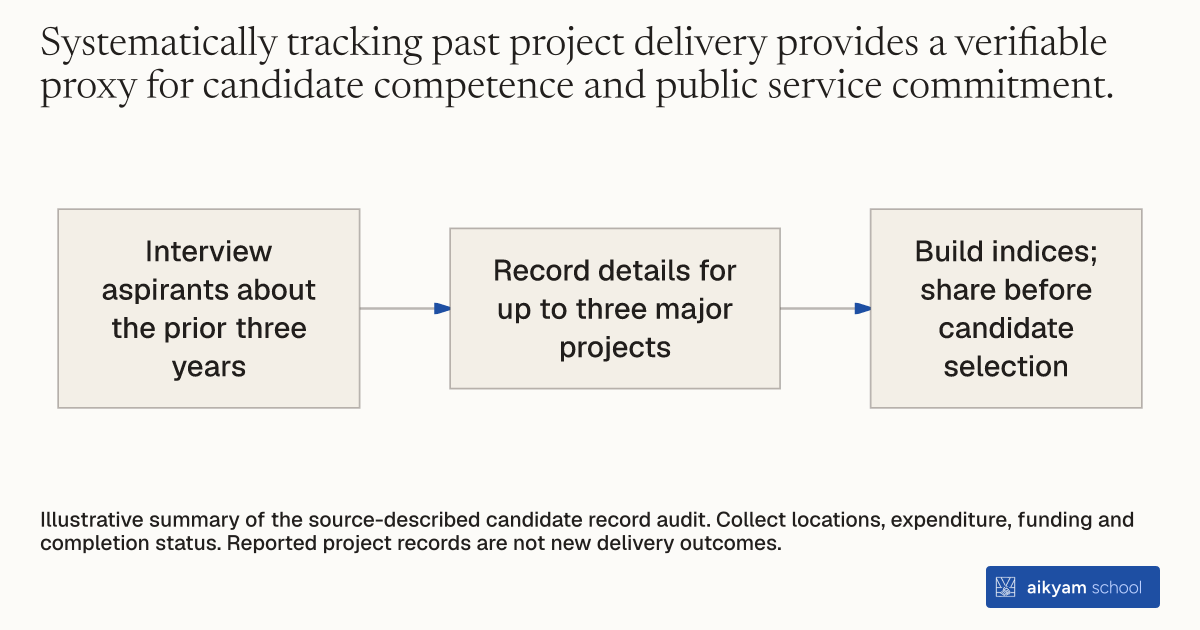
- Interview aspirants about the prior three years
- Record details for up to three major projects
- Build indices; share before candidate selection
Illustrative summary of the source-described candidate record audit. Collect locations, expenditure, funding and completion status. Reported project records are not new delivery outcomes.
See source →How
When to use
Political party officials in developing countries often lack objective data on candidates' prior performance in delivering community development projects. Without a systematic audit, selection decisions risk favoring party loyalty over practical competence. Auditing and scoring aspirants' past contributions to local public infrastructure, education, and agriculture enables party leaders and voters to evaluate candidate quality objectively.
Audit and score candidate aspirants' prior involvement in local public goods projects across constituencies during the candidate screening process.
- Deploy survey enumerators to conduct intake interviews with candidate aspirants seeking political party nominations.
- Inquire about all development projects the candidate managed or funded in the constituency over the preceding three years.
- Collect detailed project data including precise physical location, total expenditure, funding sources, and completion status for up to three major projects per candidate.
- Categorize reported activities into public infrastructure, classroom rehabilitation, agricultural support, or healthcare facility improvements.
- Aggregate project counts and expenditure values into a standardized economic development record index.
- Share compiled public goods performance scores with party executives and rank-and-file voters prior to official candidate selection.
Why it works
Revealing this information allows voters and party officials—who both value public goods provision—to identify and select higher-performing candidates.
Example
Enumerators audited 390 candidate aspirants across 80 Parliamentary constituencies in Sierra Leone for the 2018 elections, documenting that 82 percent had completed at least one project in small-scale infrastructure, education, agriculture, or health over the preceding three years.
About the study
Participants
390 candidate aspirants across 80 Parliamentary constituencies in Sierra Leone, where 89 percent were male, averaging 47.56 years of age and 15.32 years of education, with 80 percent having university education.
Study Design
A randomized controlled trial compiling candidate public goods records into standardized indices and testing the impact of revealing candidate information to voters and party officials across 92 party-races.
Results
Selected candidates in treated constituencies had delivered 0.46 more local public goods projects over the prior three years relative to a control baseline mean of 2.07 projects, representing a 22 percent increase in public goods provision.