Research survey
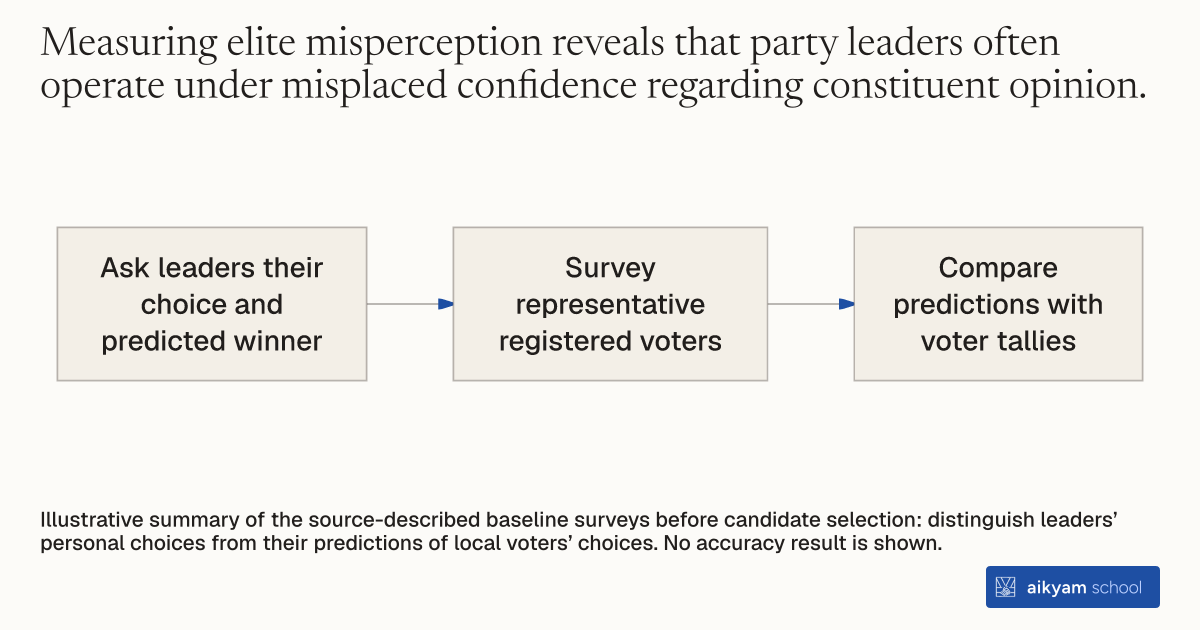
Compare leaders’ predictions with voter preferences
- Ask leaders their choice and predicted winner
- Survey representative registered voters
- Compare predictions with voter tallies
Illustrative summary of the source-described baseline surveys before candidate selection: distinguish leaders’ personal choices from their predictions of local voters’ choices. No accuracy result is shown.
See source →How
When to use
Party leaders in developing nations frequently assume that they know which candidate aspirants their constituents prefer. However, high travel and communication costs create severe information asymmetries that lead officials to misjudge public opinion. Administering dual-preference survey questions to party leaders diagnoses information bottlenecks by contrasting elites' assumed voter choices against actual constituent preferences.
Evaluate party elite information constraints by surveying local party executives on their personal candidate choices and their predictions of constituent voter preferences.
- Identify constituency-level, district-level, and national executive officials involved in candidate nomination decisions.
- Deploy field enumerators to conduct in-person baseline surveys with key party executives before candidate selections occur.
- Ask each official to name their own top-ranked candidate aspirant for the party nomination symbol in their constituency.
- Ask each official to predict which candidate aspirant would win a direct primary vote among local registered voters.
- Survey a representative sample of registered voters across local registration centers to determine true constituent first-choice preferences.
- Compare party leaders' predictions against actual voter survey data to measure baseline rates of elite misperception.
Why it works
Demonstrating this information gap proves that selection distortions stem from lack of voter data rather than conflicting preferences, encouraging party leaders to adopt democratic primary polling.
Example
Researchers surveyed 239 party officials across 80 Parliamentary constituencies in Sierra Leone prior to the 2018 elections, asking each leader to name their preferred candidate and predict the primary winner among local voters.
About the study
Participants
239 party officials (81 percent male, averaging 46.15 years of age and 12.15 years of education, with 34 percent having university education) across 80 Parliamentary constituencies in Sierra Leone.
Study Design
A baseline survey administered to party executives across 92 party-races, comparing predicted primary winners to actual voter preference tallies from 7,544 representative registered voter household surveys.
Results
While 90 percent of party officials presumed local voters shared their first candidate choice, voters agreed with them only 52 percent of the time, and officials accurately guessed the true primary winner only 50 percent of the time (with zero officials guessing correctly in 33 percent of races).