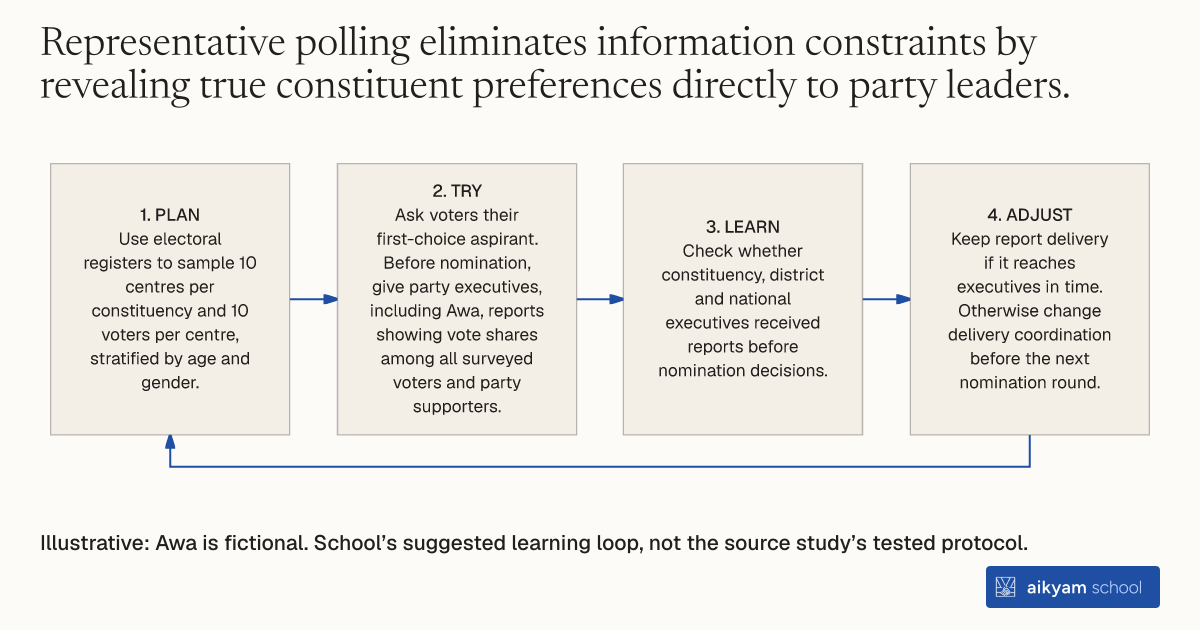
Try, learn and adjust
Check voter reports reach party leaders before nomination
- Plan: Use electoral registers to sample 10 centres per constituency and 10 voters per centre, stratified by age and gender.
- Try: Ask voters their first-choice aspirant. Before nomination, give party executives, including Awa, reports showing vote shares among all surveyed voters and party supporters.
- Learn: Check whether constituency, district and national executives received reports before nomination decisions.
- Adjust: Keep report delivery if it reaches executives in time. Otherwise change delivery coordination before the next nomination round.
Illustrative: Awa is fictional. School’s suggested learning loop, not the source study’s tested protocol.
See source →School’s suggested learning loop: observe timely report delivery; reports are non-binding and do not guarantee a particular nominee.
How
When to use
Political party officials in developing countries often lack reliable information on local voter preferences due to high transport and communication costs. This information constraint causes party leaders to misjudge candidate popularity and nominate candidates who diverge from voter choices. Conducting representative in-person opinion polling delivers aggregated constituent preference data directly to party executives before nomination decisions.
Conduct representative in-person opinion polling of registered voters across constituency registration centers and present aggregated results to party officials prior to candidate nominations.
- Obtain official voter registry lists from the national electoral commission for targeted constituencies.
- Randomly select 10 voter registration centers per constituency, representing 40 percent of centers.
- Randomly select 10 registered voters per selected center from the official registry, stratifying sampling on age and gender.
- Deploy survey enumerators to conduct in-person household interviews, asking sampled voters which candidate aspirant is their first choice for the party nomination symbol.
- Aggregate survey responses into a one-page report displaying vote shares for each aspirant among all surveyed voters and among party supporters.
- Deliver printed report copies directly to constituency, district, and national party executives before official candidate lists are finalized.
Why it works
Because party officials and ordinary voters share common preferences for candidate quality, providing clear evidence of voter popularity allows party leaders to align candidate nominations with voter choices without sacrificing candidate quality.
Example
Researchers partnered with the SLPP and APC political parties in Sierra Leone to poll 7,544 registered voters across 80 constituencies for the 2018 Parliamentary elections, averaging 94 completed surveys per constituency across 10 polling centers and delivering one-page reports to party executives prior to candidate registration.
About the study
Participants
92 party-races across 80 Parliamentary constituencies in Sierra Leone, encompassing 7,544 surveyed registered voters (43 percent with no formal schooling, averaging 4.86 years of education) and 390 candidate aspirants.
Study Design
A randomized controlled trial assigning 23 treatment and 23 control constituencies independently for two major political parties, using stratified voter sampling from National Electoral Commission registries and in-person household surveys.
Results
Delivering voter reports increased the rate at which parties nominated voters' first-choice candidates by 22.96 percentage points (from 37.8 percent in control races to 60.7 percent in treatment races) and selected candidates who had provided 0.46 more local public goods projects over the prior three years (a 22 percent increase).