Try, learn and adjust
Check conservation payments and adopted practices
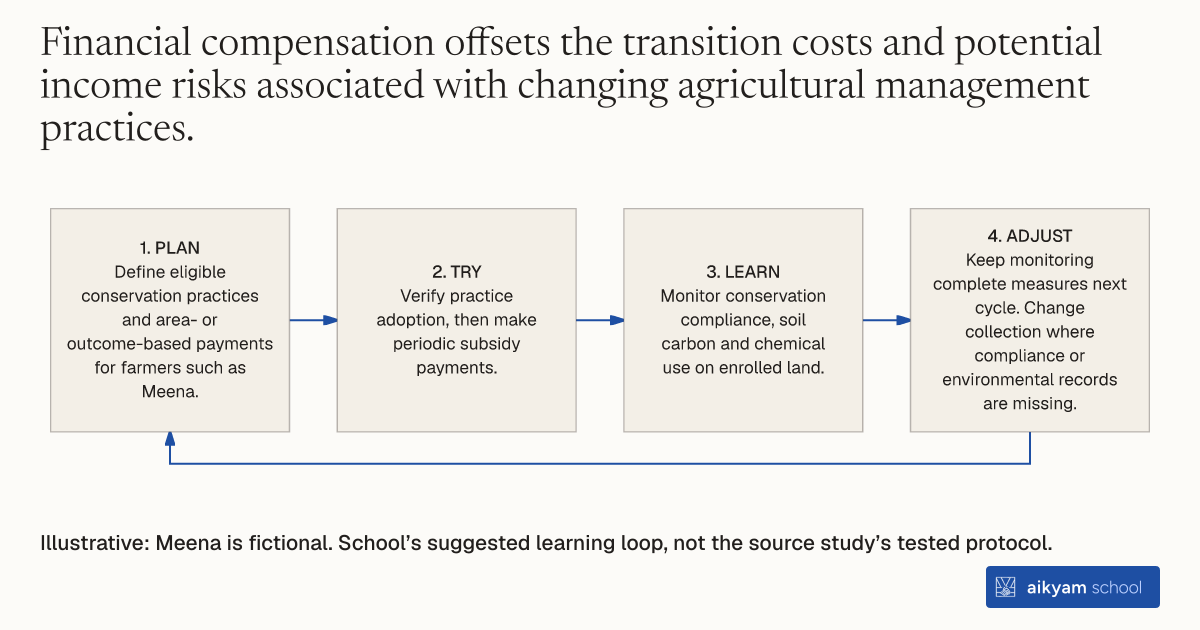
- Plan: Define eligible conservation practices and area- or outcome-based payments for farmers such as Meena.
- Try: Verify practice adoption, then make periodic subsidy payments.
- Learn: Monitor conservation compliance, soil carbon and chemical use on enrolled land.
- Adjust: Keep monitoring complete measures next cycle. Change collection where compliance or environmental records are missing.
Illustrative: Meena is fictional. School’s suggested learning loop, not the source study’s tested protocol.
See source →School’s suggested learning loop: observe adopted practices, payments, soil carbon and chemical use. The described scheme offers compensation exceeding 5% of average farm income; the loop is not proof of carbon gains.
How
When to use
Agricultural operations emit significant greenhouse gases and contribute to environmental degradation through synthetic inputs and intensive tillage. Farmers face financial uncertainty and transition costs when adopting sustainable soil and land management practices. Carbon-farming agri-environmental schemes compensate farmers for shifting land to low-emission agricultural practices.
Compensate agricultural producers for implementing environmental land management and carbon-sequestration practices.
- Define eligible conservation practices, including organic farming conversion, crop diversification, grass buffer strip installation, and cover crop planting.
- Establish payment calculations based on environmental outcomes or per-hectare land enrollment areas.
- Offer financial compensation exceeding five percent of average farm income to motivate farmer enrollment.
- Distribute periodic subsidy payments to participating agricultural producers following verified practice adoption.
- Monitor conservation compliance, soil carbon sequestration, and chemical reduction across participating farm acreage.
Why it works
Calculating payments on a per-hectare basis directly incentives farmers to scale up sustainable land coverage.
Example
Agri-environmental programs across Spain, Germany, France, the United Kingdom, and Italy compensated farmers for adopting conservation practices. Participating farms expanded cover crop acreage, maintained grasslands, and reduced synthetic fertilizer and herbicide usage, with conversion to organic farming exhibiting high program additionality.
About the study
Participants
Agricultural producers and farm holdings across European countries including Spain, Germany, France, the United Kingdom, and Italy.
Study Design
Difference-in-differences, propensity score matching, and natural experiments evaluating agri-environmental scheme participation and farm management practices.
Results
Carbon-farming payments effectively expanded conservation areas, maintained grasslands, increased organic farming conversion, and reduced chemical inputs. Programs proved most effective when payments exceeded five percent of farmer income, with per-hectare calculations driving higher environmental performance than flat per-farm payments.