Procedure
Screen conservation subsidy applications
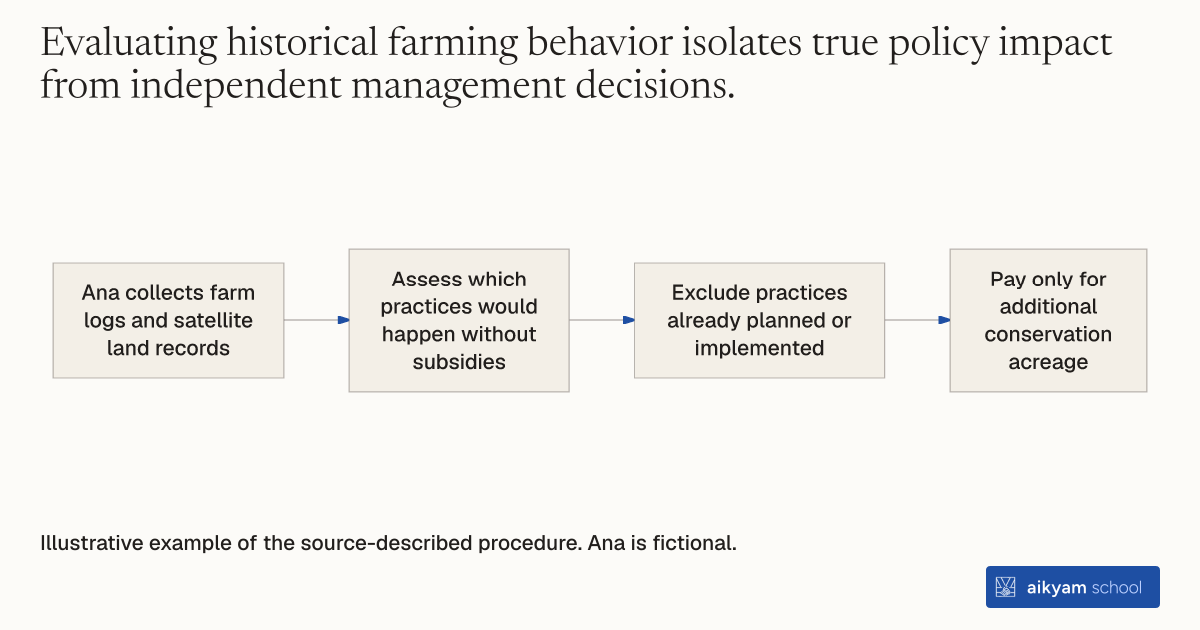
- Ana collects farm logs and satellite land records
- Assess which practices would happen without subsidies
- Exclude practices already planned or implemented
- Pay only for additional conservation acreage
Illustrative example of the source-described procedure. Ana is fictional.
See source →How
When to use
Agri-environmental subsidy programs pay farmers to adopt conservation practices like cover cropping or buffer strips. However, high rates of windfall effects occur when landowners claim payments for practices they would have adopted without subsidy support. Conservation agencies need to screen counterfactual baselines to avoid spending public funds on non-additional agricultural activities.
Screen agricultural applicants against historical land management records before disbursing conservation subsidies.
- Program administrators collect historical farm management logs and satellite land records across applicant parcels.
- Agricultural analysts evaluate counterfactual adoption rates to determine if practices would occur without subsidies.
- Program officers screen out practice applications that farmers already planned or implemented prior to enrollment.
- Financial officers disburse agri-environmental payments exclusively to farm operations offering additional conservation acreage.
Why it works
Filtering out windfall participants concentrates conservation budgets on farmers who require financial incentives to adopt sustainable land practices.
Example
An evaluation of agri-environmental schemes in France showed that subsidies for organic farming and buffer strips suffered from substantial windfall effects, as many participating farmers would have maintained or adopted those practices without public funding.
About the study
Participants
Agricultural landowners across France participating in agri-environmental payment schemes (Chabé-Ferret & Subervie, 2013).
Study Design
Quasi-experimental difference-in-differences matching estimator evaluating conservation practice additionality across participating farms.
Results
Agri-environmental payments induced substantial windfall effects, where a significant share of subsidized practices would have occurred under counterfactual baseline conditions without program intervention.