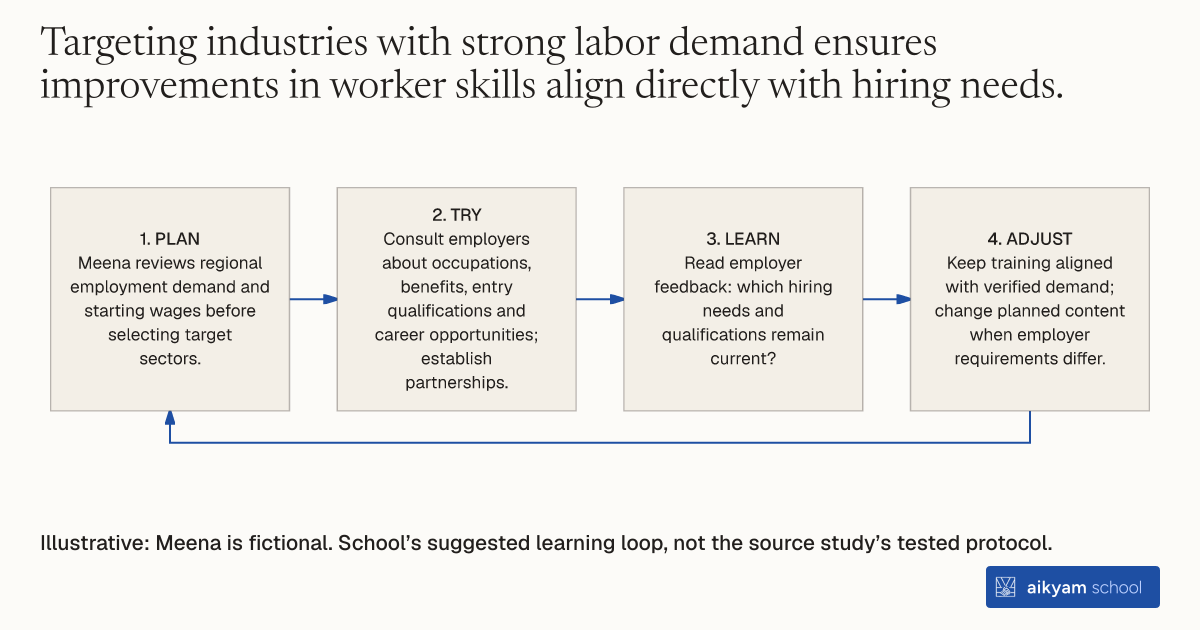
Try, learn and adjust
Check training plans against local hiring needs
- Plan: Meena reviews regional employment demand and starting wages before selecting target sectors.
- Try: Consult employers about occupations, benefits, entry qualifications and career opportunities; establish partnerships.
- Learn: Read employer feedback: which hiring needs and qualifications remain current?
- Adjust: Keep training aligned with verified demand; change planned content when employer requirements differ.
Illustrative: Meena is fictional. School’s suggested learning loop, not the source study’s tested protocol.
See source →School’s suggested learning loop, not a tested protocol. Observe regional labour data and employer-confirmed hiring requirements.
How
When to use
Traditional workforce programs place job seekers into any available low-wage vacancy without targeting growing industries. This approach leaves non-college workers stuck in low-paying positions with minimal room for career growth. Program managers solve this problem by selecting local industry sectors with strong labor demand and rising wages.
Identify and target high-growth local industry sectors prior to designing workforce training programs.
- Analyze regional labor market data to identify sectors with rising employment demand and higher starting wages.
- Select target industries such as health care, information technology, manufacturing, financial services, or environmental remediation.
- Consult local employers in target sectors to identify specific high-demand occupations offering benefits and career advancement opportunities.
- Establish formal employer partnerships to verify ongoing hiring needs and required entry qualifications.
- Align all subsequent technical skills training directly with the workforce demands of selected sectors.
Why it works
This strategy increases the share of participants who enter higher-paying jobs rather than short-term low-wage roles.
Example
Per Scholas targeted the information technology sector in the Bronx, training job seekers for A Plus and Network Plus computer repair certifications to meet local employer demand.
About the study
Participants
Human low-income adult and youth job seekers across nine evaluated sectoral programs in the United States.
Study Design
Four randomized evaluations compared outcomes of participants trained in targeted sectors against control group members receiving standard services over two to eleven years.
Results
Sectoral training in targeted industries increased Year 2 information technology employment by 41 percentage points at Per Scholas (61 percent versus 20 percent, p < 0.01) and increased long-term quarterly earnings by 33.5 percent at YearUp (p < 0.01).