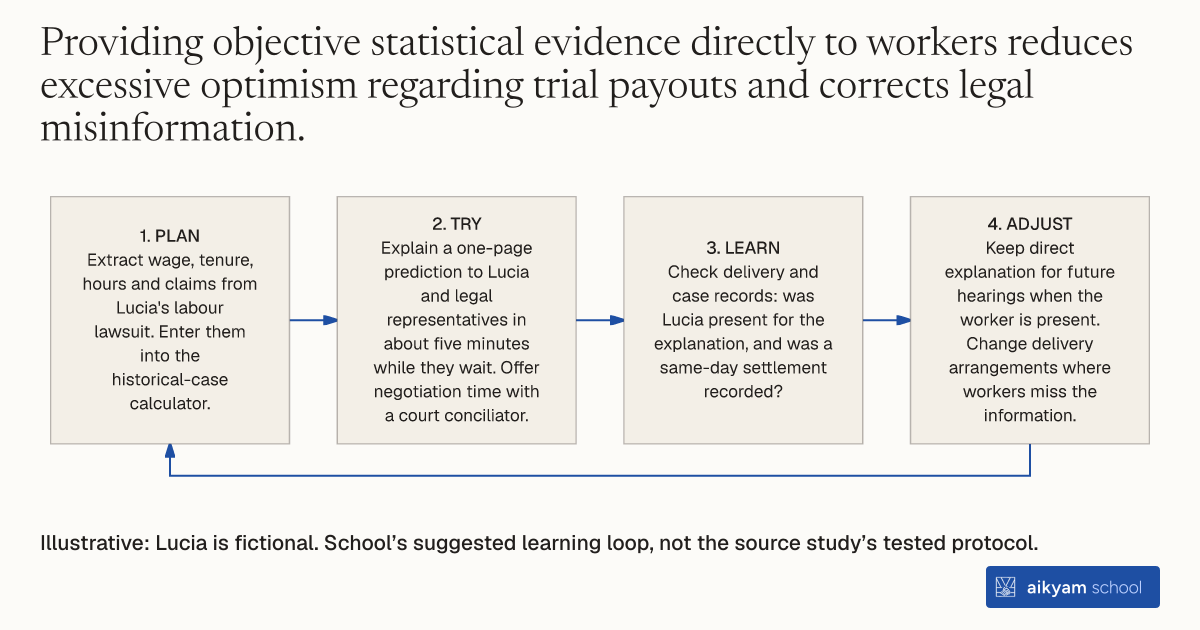
Try, learn and adjust
Check workers receive case predictions directly
- Plan: Extract wage, tenure, hours and claims from Lucia's labour lawsuit. Enter them into the historical-case calculator.
- Try: Explain a one-page prediction to Lucia and legal representatives in about five minutes while they wait. Offer negotiation time with a court conciliator.
- Learn: Check delivery and case records: was Lucia present for the explanation, and was a same-day settlement recorded?
- Adjust: Keep direct explanation for future hearings when the worker is present. Change delivery arrangements where workers miss the information.
Illustrative: Lucia is fictional. School’s suggested learning loop, not the source study’s tested protocol.
See source →School's suggested, untested loop: observe worker presence, prediction delivery and settlements; forecasts are not guaranteed court outcomes.
How
When to use
Dismissed workers in labor disputes often hold wildly overconfident expectations about court awards and lack knowledge of legal entitlements. This overconfidence and misinformation lead to low settlement rates and severe case backlogs in labor courts. The method provides case-specific statistical predictions to plaintiffs and legal representatives during ongoing court hearings to align expectations and encourage settlement.
Provide personalized statistical outcome predictions to litigants during court hearing waiting periods to facilitate settlement negotiations.
- Extract case characteristics, such as daily salary, tenure, weekly hours, and legal claims, from the initial lawsuit filing.
- Enter the extracted variables into a statistical calculator calibrated on historical concluded court cases.
- Print a single-page prediction sheet detailing statutory legal entitlements, probabilities of five case endings, average duration, and expected monetary recovery.
- Present and explain the printed prediction sheet to the worker and legal representatives during their hearing waiting time in about 5 minutes.
- Offer the parties a short delay before their hearing starts to negotiate with the assistance of an official court conciliator.
Why it works
Presenting the information directly to plaintiffs overcomes agency problems where private lawyers fail to share realistic settlement prospects with their clients.
Example
In the Mexico City Labor Court, research enumerators delivered personalized calculator prediction sheets to parties in 315 treatment cases during court hearings in Subcourt 7 between March and May 2016. On the day of treatment, same-day settlement rates increased by 5.2 percentage points overall, and by 15.5 percentage points when the employee was physically present.
About the study
Participants
636 ongoing labor court cases (315 treated, 321 control) involving dismissed workers in Subcourt 7 of the Mexico City Labor Court, where 48 percent of plaintiffs were female with average tenure of 4.17 years and daily wage of 470 pesos.
Study Design
Randomized controlled trial assigning eligible ongoing court hearings in equal proportions to receive personalized statistical predictions generated from 2,158 historical concluded cases or standard court proceedings.
Results
The treatment increased same-day settlement rates by 5.2 percentage points from a 6.2 percent control mean, rising to a 15.5 percentage point increase when the worker was physically present, while reducing case duration by nearly 4 months for cases with private lawyers.