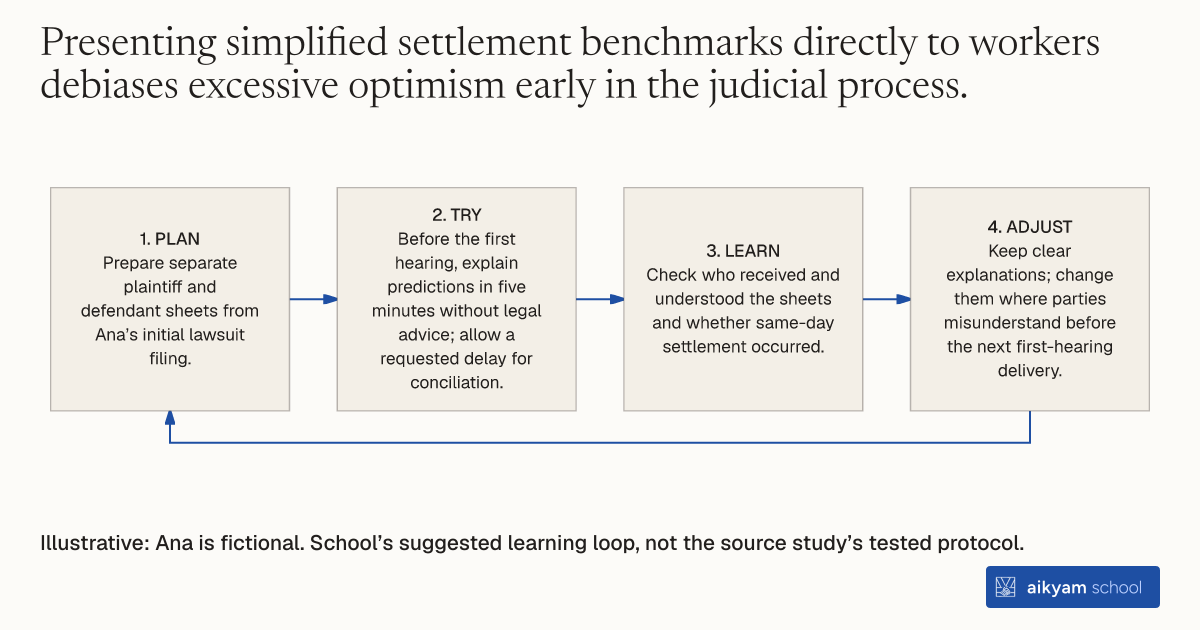
Try, learn and adjust
Check first-hearing predictions reach both parties
- Plan: Prepare separate plaintiff and defendant sheets from Ana’s initial lawsuit filing.
- Try: Before the first hearing, explain predictions in five minutes without legal advice; allow a requested delay for conciliation.
- Learn: Check who received and understood the sheets and whether same-day settlement occurred.
- Adjust: Keep clear explanations; change them where parties misunderstand before the next first-hearing delivery.
Illustrative: Ana is fictional. School’s suggested learning loop, not the source study’s tested protocol.
See source →Observe party presence, sheet delivery and settlement. Predictions describe similar historical cases, not guaranteed payouts. School suggests this learning loop; it was not tested by the source.
How
When to use
Dismissed workers and employers attending their first labor court hearing frequently hold unrealistically optimistic settlement expectations. This overconfidence and legal misinformation lead to low first-hearing settlement rates and long case delays. The method delivers simplified statistical outcome predictions during first hearings to align settlement expectations early in litigation.
Provide pre-printed, simplified statistical settlement predictions to plaintiffs and defendants at their first court hearing to facilitate early settlement.
- Pre-fill and pre-print separate simplified calculator sheets for plaintiffs and defendants using initial lawsuit filings prior to hearing days.
- Display expected average settlement amounts for similar cases on the plaintiff sheet alongside the probability of receiving zero compensation at trial.
- Display expected average settlement amounts on the defendant sheet alongside the average trial recovery amount and total statutory entitlement.
- Distribute the respective calculator sheets to parties present in the subcourt waiting area before their scheduled first hearing starts.
- Have trained enumerators explain the statistical predictions to the parties in a brief 5-minute interaction without providing legal advice.
- Allow parties who wish to negotiate after reviewing the sheet to request a short hearing delay to sit with a court conciliator.
Why it works
Delivering information directly to plaintiffs circumvents agency friction where private attorneys do not share realistic settlement perspectives with clients.
Example
In five subcourts of the Mexico City Labor Court between October 2016 and February 2017, research enumerators provided pre-printed calculator sheets to 768 treated cases during first hearings. Same-day settlement rates increased by 3.9 percentage points overall, and by 14.1 percentage points when the employee was physically present.
About the study
Participants
1,096 labor court cases holding first hearings (768 treated, 328 control) across 5 subcourts of the Mexico City Labor Court, where 46 percent of plaintiffs were female with average tenure of 4.33 years and daily wage of 605 pesos.
Study Design
Randomized controlled trial assigning Fridays across five subcourts to receive pre-printed calculator sheets calibrated on 5,005 historical concluded cases or standard court proceedings.
Results
Same-day settlement rates increased by 3.9 percentage points from a 16.5 percent control mean, rising to a 14.1 percentage point increase when the worker was physically present.