Research comparison
Randomise eligible caste groups
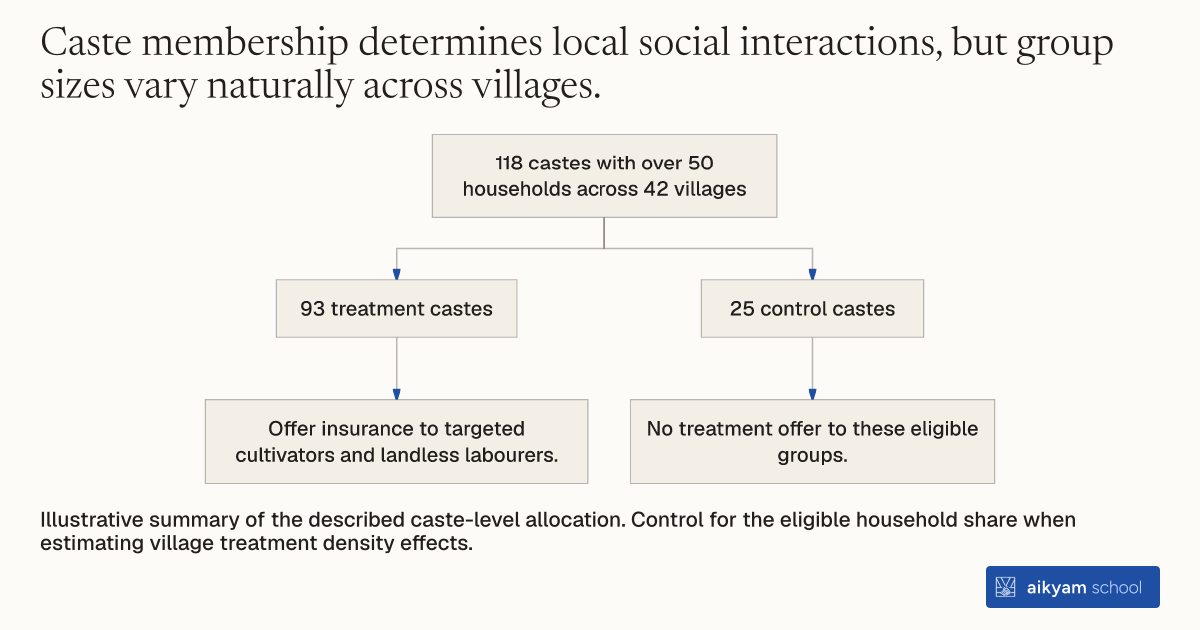
118 castes with over 50 households across 42 villages
- 93 treatment castes
- Offer insurance to targeted cultivators and landless labourers.
- 25 control castes
- No treatment offer to these eligible groups.
Illustrative summary of the described caste-level allocation. Control for the eligible household share when estimating village treatment density effects.
See source →How
When to use
Evaluators need to test market-wide spillover effects of a program across local communities. Standard individual randomization cannot create clean variation in community treatment density without confounding village size or social structure. This method provides evaluators with exogenous variation in treatment coverage across villages.
Generate exogenous community-level treatment density by stratifying sample households into social groups of varying population sizes and randomizing treatment across these groups.
- Compile a complete household listing for all target communities and identify distinct social groups like sub-castes.
- Filter out small social groups that fall below a minimum population threshold, such as 50 households per group within the community listing.
- Randomly select a subset of eligible social groups in each community to receive treatment offers while designating the remaining eligible groups as non-treated controls.
- Target treatment offers to specific occupational subgroups within the assigned treatment groups, such as 2,400 cultivators and 2,400 landless laborers across target villages.
- Control for the community-level proportion of eligible households during econometric estimation to ensure treatment density remains exogenous to community size and social concentration.
Why it works
Randomizing treatment at the caste level leverages this natural population variation to generate exogenous community-level coverage rates without introducing correlation with village size or caste concentration.
Example
In 42 rural villages across Andhra Pradesh, Uttar Pradesh, and Tamil Nadu, India, researchers selected 93 treatment castes and 25 control castes from 118 castes containing over 50 households. This design created exogenous village-level treatment density ranging from 0% to 53% for landowning cultivators and 0% to 100% for landless laborers, while maintaining statistical exogeneity when controlling for eligible population shares.
About the study
Participants
4,667 households across 118 sub-castes (jatis) in 42 rural villages across Andhra Pradesh, Uttar Pradesh, and Tamil Nadu, India.
Study Design
Clustered RCT with two-stage randomized assignment, stratifying by sub-castes with over 50 households and targeting 2,400 landowning cultivators and 2,400 landless laborers.
Results
Insurance coverage ranged from 0% to 53% for cultivators and 0% to 100% for laborers across villages, with take-up reaching 42% among targeted households, while conditioning on eligible population shares reduced correlations with village characteristics to statistically insignificant levels (p-values > 0.18).