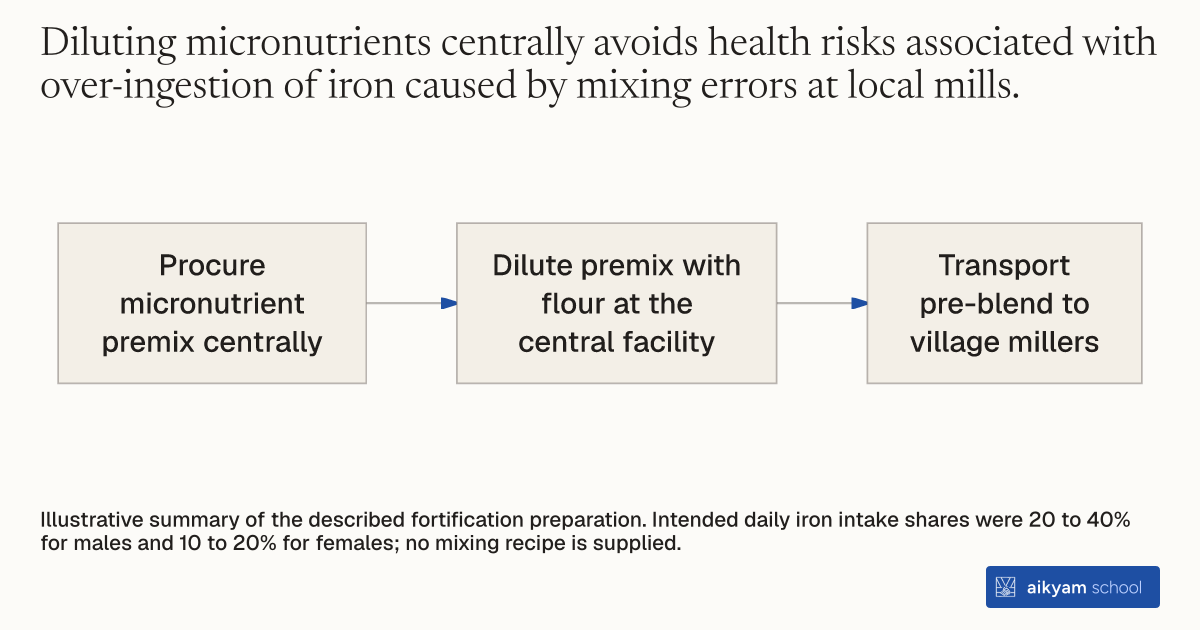
Research procedure
Prepare and deliver the pre-blend
- Procure micronutrient premix centrally
- Dilute premix with flour at the central facility
- Transport pre-blend to village millers
Illustrative summary of the described fortification preparation. Intended daily iron intake shares were 20 to 40% for males and 10 to 20% for females; no mixing recipe is supplied.
See source →How
When to use
Isolated rural populations consume locally milled grain rather than commercially processed flour and suffer from widespread iron deficiency anemia. Standard distribution of iron pills often fails because community members rarely take pills consistently over long periods. Centralized pre-mixing provides a safe, controlled way to dilute concentrated micronutrients before distributing them to local millers for village-level fortification.
Dilute concentrated micronutrient premix into flour at a central facility to create a safe pre-blend for local millers.
- Non-governmental organization staff procure concentrated micronutrient premix containing essential iron at a central facility.
- Staff mix the concentrated premix with standard flour at the central location to produce a diluted pre-blend.
- Staff calibrate the pre-blend ratio so daily flour consumption supplies 20 to 40 percent of daily iron intake for males and 10 to 20 percent for females.
- Staff transport the diluted pre-blend to local millers across participating villages for customer grain fortification.
Why it works
Centralized preparation guarantees consistent dosage quality across decentralized village millers.
Example
Seva Mandir diluted micronutrient premix into flour at its central facility in Udaipur District, India, creating a pre-blend that supplied 20 to 40 percent of daily iron intake for males and 10 to 20 percent for females across 68 villages.
About the study
Participants
2,519 adults in 134 rural villages in Udaipur District, Rajasthan, India, where over 40 percent of households lived below the poverty line.
Study Design
Randomized evaluation across 134 villages, offering fortification technology in 68 treatment villages while 66 villages served as comparison groups.
Results
Program participation reduced anemia rates by about 7 percentage points at midline when uptake was high, alongside significant reductions in weakness and fatigue symptoms.