Research steps
Record choices about saving for children
- Compare child savings with cash and other uses
- Vary child deposit against 200 pesos cash
- Implement a randomly selected choice
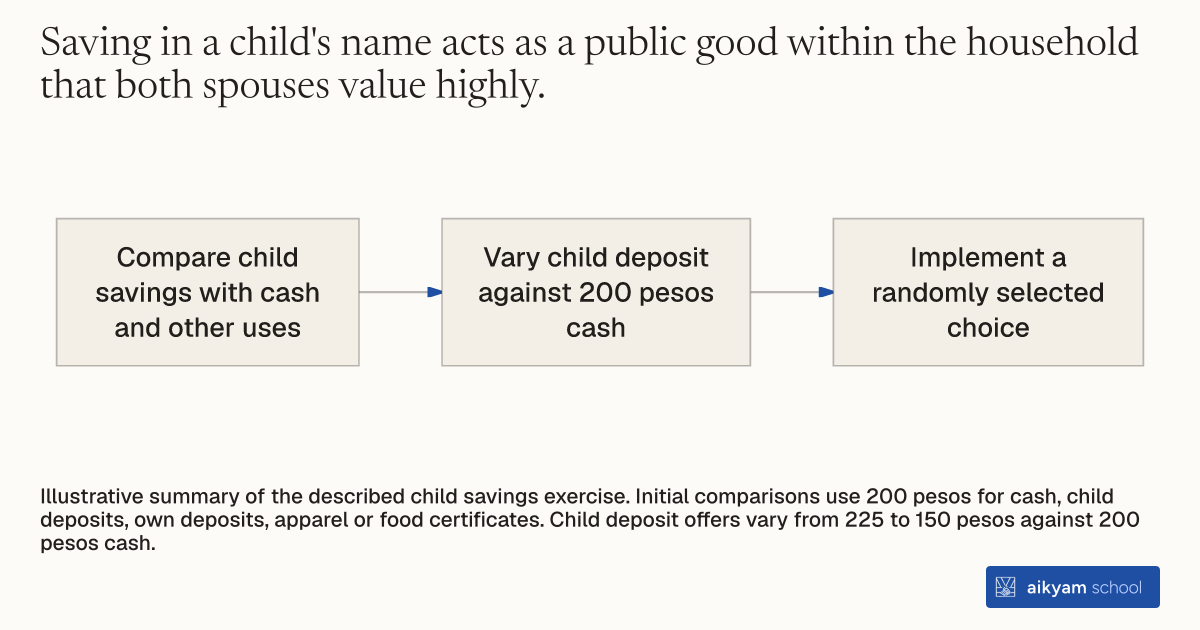
Illustrative summary of the described child savings exercise. Initial comparisons use 200 pesos for cash, child deposits, own deposits, apparel or food certificates. Child deposit offers vary from 225 to 150 pesos against 200 pesos cash.
See source →How
When to use
Married individuals often face conflicting preferences over personal consumption versus spousal bank deposits. Allocating funds to children's bank accounts provides a shared goal that reduces intra-household disagreement. This protocol measures willingness to allocate financial windfalls directly into savings accounts designated for children.
Measure willingness to save for children by offering discrete trade-offs between cash, personal consumption, and deposits into a child's bank account.
- Experimenters present each participant with choice scenarios between 200 pesos cash and 200 pesos deposited into an account in the name of their child.
- Experimenters offer trade-offs between 200 pesos in a child's savings account and a 200 peso gift certificate for personal apparel.
- Experimenters offer trade-offs between 200 pesos in a child's savings account and a 200 peso food gift certificate.
- Experimenters offer trade-offs between 200 pesos deposited into a child's account versus 200 pesos deposited into the participant's own savings account.
- Experimenters elicit willingness to pay for child savings by varying the deposit amount from 225 pesos down to 150 pesos against 200 pesos cash.
- Local bank staff open or credit designated child savings accounts based on randomly selected participant choices.
Why it works
Unlike personal accounts or spousal accounts, child savings accounts align spousal preferences and do not trigger strategic hiding or retaliatory spending.
Example
Researchers tested married individuals at Green Bank in Mindanao, Philippines, offering choices to deposit 200 pesos into a child's savings account over personal gift certificates. When given the choice between a child's account and an own account, 54 percent of men and 73 percent of women in Private chose the child's savings account.
About the study
Participants
146 married couples (291 individuals) recruited near Green Bank in Mindanao, Philippines, with average age of 43 and 19 years married.
Study Design
Randomized field experiment evaluating choices between cash, gift certificates, own account direct deposit, and child account direct deposit across Private, Public, and Negotiation treatment conditions.
Results
Both men and women displayed high willingness to pay for child savings, giving up an average of 11.00 to 17.50 pesos for direct deposit into a child's account; this preference did not vary significantly across Private, Public, or Negotiation conditions.