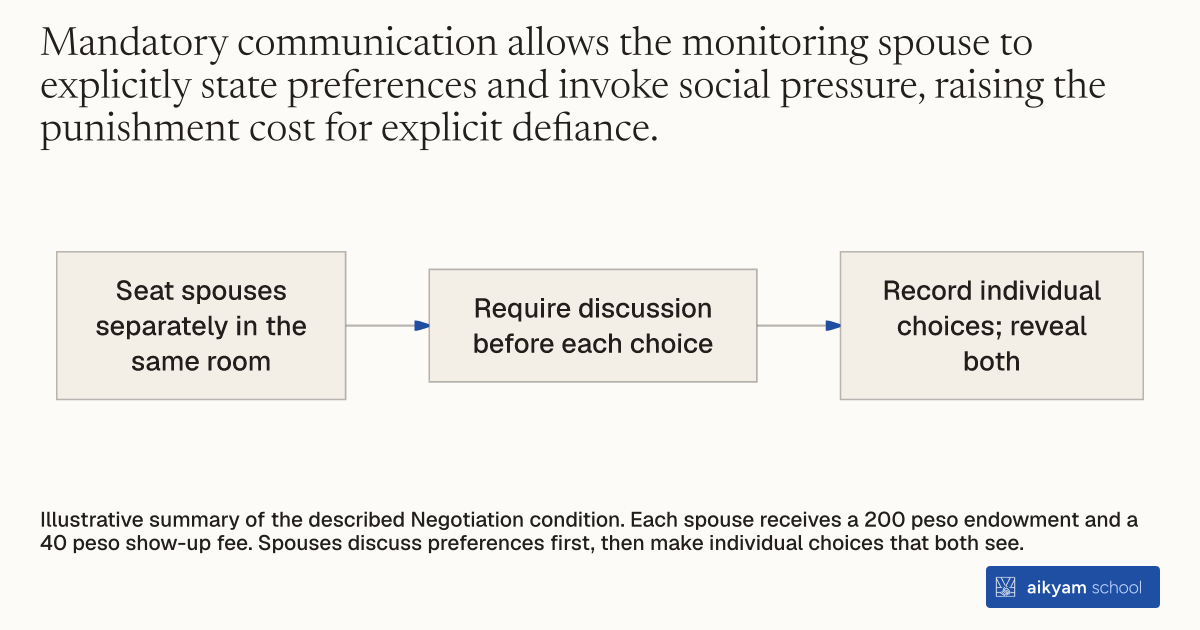
Research steps
Discuss before making individual choices
- Seat spouses separately in the same room
- Require discussion before each choice
- Record individual choices; reveal both
Illustrative summary of the described Negotiation condition. Each spouse receives a 200 peso endowment and a 40 peso show-up fee. Spouses discuss preferences first, then make individual choices that both see.
See source →How
When to use
When financial decisions are publicly observable between married couples, non-managing spouses may spend funds on immediate consumption to avoid spousal reallocation. Enforced communication allows spouses to state explicit preferences and reinforce marital contracts before making financial allocations. This protocol structures mandatory pre-decision negotiation to evaluate how joint communication influences spousal income choices.
Enforce structured spousal communication before married individuals make observable financial allocation decisions.
- Bring married couples together into a shared testing room in a local bank setting.
- Seat husbands and wives at separate tables while informing both that each receives a 200 peso endowment and 40 peso show-up fee.
- Instruct couples to speak with each other, discuss what would be best to do, and state their preferences before recording choices.
- Allow spouses to use verbal persuasion and state family needs while discussing each financial choice option.
- Experimenters require each participant to record their individual allocation decisions immediately following the discussion.
- Local staff verify and record both choices, revealing decisions immediately to both spouses.
Why it works
Under explicit monitoring, non-managing spouses deposit money into the managing spouse's account rather than committing funds to personal consumption.
Example
Researchers tested 50 married men and 50 married women under negotiation conditions at Green Bank in Mindanao, Philippines. When required to communicate before making choices, 38 percent of men deposited their 200 pesos into their wives' accounts and 30 percent committed it to consumption.
About the study
Participants
146 married couples (291 individuals) recruited near Green Bank in Mindanao, Philippines, with average age of 43 and 19 years married.
Study Design
Randomized field experiment assigning couples to Negotiation, Public, or Private conditions to evaluate allocation choices across 200 peso endowments.
Results
In Negotiation, 38 percent of men deposited money into their wives' accounts compared to 19 percent in Public (Fisher's exact p-value = 0.015). Only 30 percent of men chose committed consumption in Negotiation, down from 58 percent in Public.