Research procedure
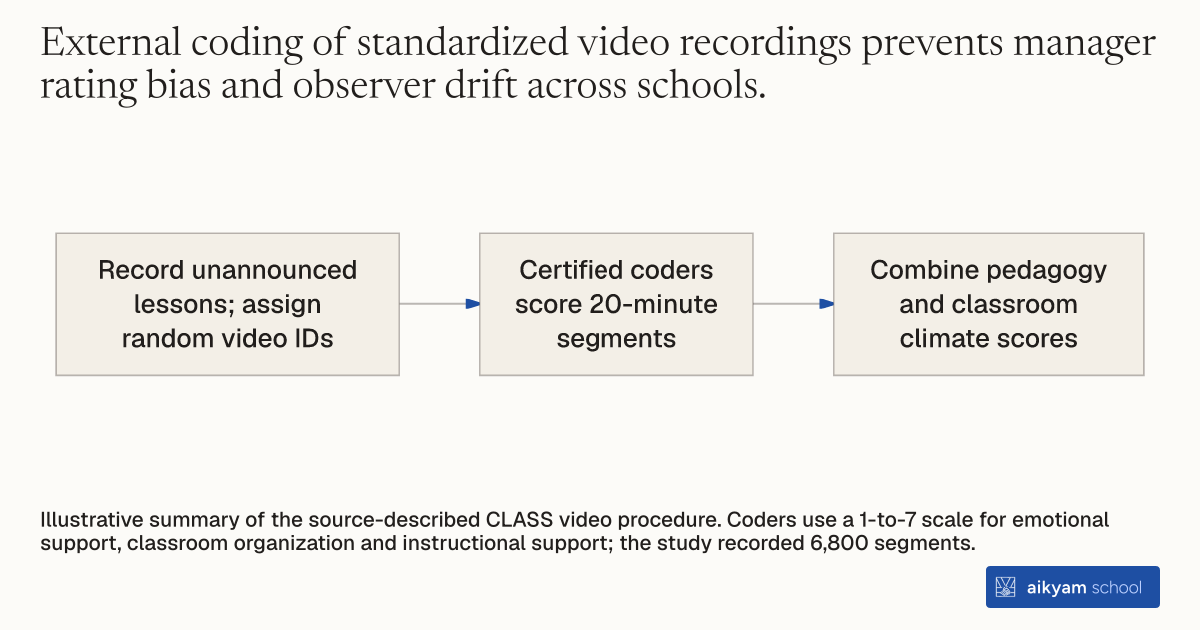
Score classroom videos consistently
- Record unannounced lessons; assign random video IDs
- Certified coders score 20-minute segments
- Combine pedagogy and classroom climate scores
Illustrative summary of the source-described CLASS video procedure. Coders use a 1-to-7 scale for emotional support, classroom organization and instructional support; the study recorded 6,800 segments.
See source →How
When to use
Educational evaluations require reliable measures of classroom pedagogical quality beyond standardized student test scores. Unannounced direct observations risk observer bias and logistical disruption across geographically dispersed schools. Standardized video recordings scored by certified external coders allow consistent, objective evaluation of teacher-student interactions and pedagogical climate.
Measure classroom teaching quality by recording unannounced full-period lessons and scoring them using the standardized CLASS rubric.
- Deploy enumerators with standardized video recording equipment to record unannounced, full-period lessons across core academic subjects.
- Anonymize video files by assigning random identifiers prior to external scoring and transmission.
- Train coders to gold-standard certification on the Classroom Assessment Scoring System (CLASS) rubric covering secondary and upper-elementary grades.
- Score video recordings across 20-minute segments on a 1-to-7 point scale spanning dimensions of emotional support, classroom organization, and instructional support.
- Track specific teacher and student behaviors during each 20-minute segment, including time dedicated to exam test preparation and student-centered inquiry.
- Calculate composite pedagogical and climate scores for each classroom observation to evaluate teaching quality across contract regimes.
Why it works
Using a validated multi-dimensional rubric isolates behavioral changes in teaching practices, such as shifting time toward test drilling versus student-centered instruction under different incentive structures.
Example
A research team in Pakistan recorded 6,800 classroom video segments across 234 private schools to measure teacher pedagogy under flat, objective, and subjective raises. Video coding revealed that objective test-score incentives caused a 5-fold increase in test preparation time and reduced pedagogical quality scores by 0.07 points.
About the study
Participants
6,800 recorded 20-minute classroom video segments from core subject classrooms in 234 private schools in Pakistan (grades 4–13).
Study Design
Randomized controlled trial (RCT) using unannounced video recordings scored by CLASS-certified independent coders on a 1–7 scale to compare flat 5% raises, subjective manager raises, and objective test-score raises.
Results
Objective incentives increased classroom time spent on test preparation from 0.14 to 0.76 minutes per 20-minute segment (p = 0.00455), decreased overall CLASS pedagogy scores by 0.0713 points (p = 0.123), and decreased positive classroom climate scores by 0.10 points.