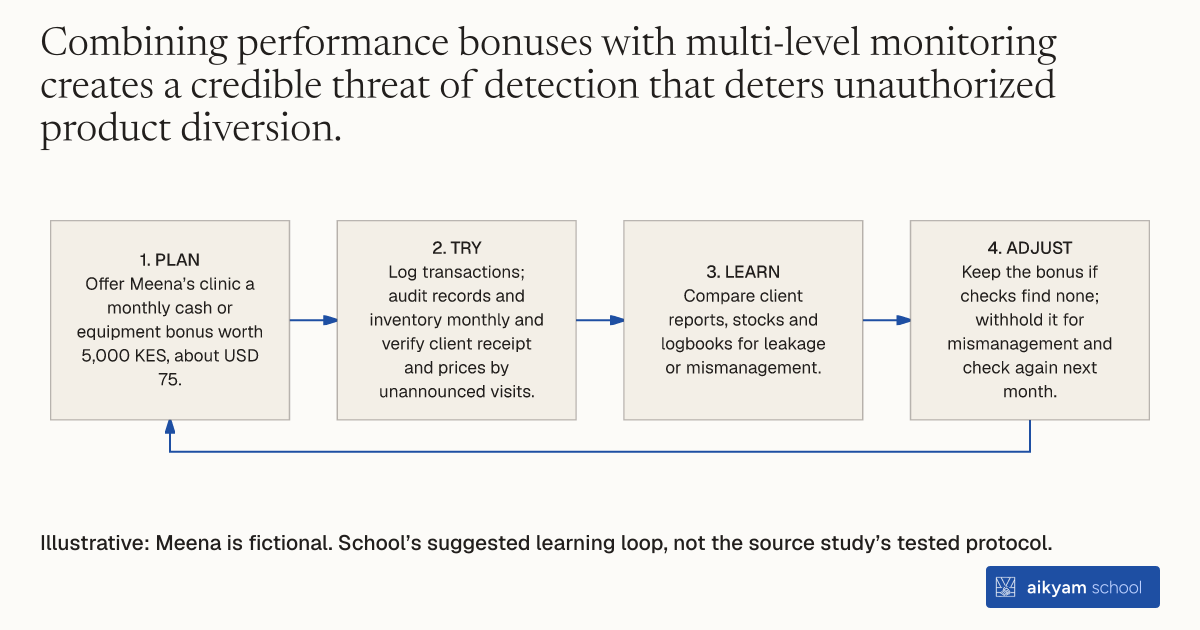
Try, learn and adjust
Check clinic bonuses follow distribution audits
- Plan: Offer Meena’s clinic a monthly cash or equipment bonus worth 5,000 KES, about USD 75.
- Try: Log transactions; audit records and inventory monthly and verify client receipt and prices by unannounced visits.
- Learn: Compare client reports, stocks and logbooks for leakage or mismanagement.
- Adjust: Keep the bonus if checks find none; withhold it for mismanagement and check again next month.
Illustrative: Meena is fictional. School’s suggested learning loop, not the source study’s tested protocol.
See source →Inventory, recipient eligibility, prices and records; no assumed absence of leakage. School’s suggested learning loop, not a source-tested cycle.
How
When to use
Subsidized public health programs operating through local facilities face risks of product diversion and financial mismanagement by staff. Offering structured monetary bonuses combined with random auditing aligns health worker incentives and protects program integrity. Administrators use this management approach to ensure subsidized commodities reach intended beneficiaries in rural health centers.
Provide monthly financial rewards to health clinics paired with random unannounced audits to prevent product diversion and enforce administrative compliance.
- Program administrators offer health clinics a monthly cash bonus or equipment grant worth 5,000 Kenyan shillings (\$75) for maintaining proper distribution procedures.
- Health center staff log every transaction and beneficiary detail in official administrative record books during patient check-ups.
- Field auditors conduct random monthly spot checks of clinic logbooks to reconcile inventory levels against reported distribution numbers.
- Surveyors perform unannounced visits to a sample of registered clients to verify receipt and confirm the exact purchase price paid.
- Program managers withhold the monthly bonus if audits uncover any financial mismanagement, record falsification, or sales to ineligible non-program clients.
Why it works
Monetary rewards compensate clinic staff for the extra effort required to maintain accurate administrative records.
Example
Administrators offered 20 public health centers in western Kenya a monthly 5,000 Kenyan shilling bonus tied to audit checks and beneficiary verifications. No mismanagement occurred across the 5 free distribution clinics, whereas 4 of 11 clinics assigned to positive prices lost their bonuses for selling program bed nets to ineligible non-prenatal clients.
About the study
Participants
20 rural public health centers across four districts in western Kenya (Busia, Bungoma, Butere, and Mumias).
Study Design
Randomized incentive and auditing intervention evaluated across 16 treatment clinics via monthly record book spot checks and unannounced follow-up visits to 246 sampled beneficiaries.
Results
Zero cases of product leakage or mismanagement occurred across 5 free distribution clinics, while 4 of 11 positive-price clinics engaged in leakage by selling program nets to ineligible recipients.